The Best Fluffy Pancakes recipe you will fall in love with. Full of tips and tricks to help you make the best pancakes.
How to Choose a Mandoline Slicer for High-Volume Kitchens: Because Dull Knives and Sore Arms Aren’t an Option
Let me set the scene: It’s 5:30 PM on a Friday night at a bustling downtown bistro. The kitchen is a controlled chaos of sizzling pans, clattering plates, and the occasional curse word when someone nearly slices their finger open. The prep cook, let’s call him Marco, is hunched over a cutting board, wrist aching, trying to julienne 20 pounds of carrots for the night’s special. Meanwhile, the executive chef is tapping her foot, glaring at the clock like it personally offended her. Sound familiar?
I’ve been there, both as the frustrated prep cook and the impatient chef. And let me tell you, nothing transforms a kitchen’s efficiency (and morale) like the right mandoline slicer for high-volume kitchens. But here’s the catch: not all mandolines are created equal. The one you grabbed off Amazon for your home kitchen? It’ll last about 10 minutes in a professional setting before it either breaks, slows you down, or becomes a safety hazard. High-volume kitchens need something built for endurance, speed, and precision, like a culinary workhorse that won’t buck you off mid-service.
So, how do you choose the right one? Is it all about the blade? The material? The price? (Spoiler: It’s not *just* about the price, though that plays a role.) Over the years, I’ve tested, broken, and cursed at enough mandolines to fill a small warehouse. Some were overhyped paperweights; others became indispensable tools that saved my team hours of prep time. In this guide, I’ll walk you through everything you need to know, from the non-negotiable features to the “nice-to-haves” that might actually be worth the splurge. By the end, you’ll know exactly what to look for (and what to avoid) so you can stop wasting time and start slicing like a pro.
Oh, and full disclosure: I’m not sponsored by any brand. My only loyalty is to the truth, and to not losing a fingertip on a busy Saturday night.
The Unsexy Truth About Mandoline Slicers in High-Volume Kitchens
Before we dive into the nitty-gritty, let’s address the elephant in the room: mandolines have a reputation. Some chefs swear by them; others treat them like a necessary evil. Why the divide? Because in a high-volume kitchen, a mandoline isn’t just a tool, it’s a system. It’s not enough for it to slice well; it needs to integrate seamlessly into your workflow, withstand abuse, and not turn your prep area into a war zone. Here’s what most guides won’t tell you:
- Speed isn’t everything. Sure, a fast mandoline is great, but if it sacrifices precision or safety, you’re just creating more work for yourself (or your sous chef).
- Durability > flashy features. A mandoline with 10 blade attachments is useless if the housing cracks after a week of heavy use.
- Your team’s skill level matters. A pro-level mandoline in the hands of an untrained cook is a recipe for disaster (literally).
- Cleanup can’t be an afterthought. If it takes 20 minutes to disassemble and sanitize, you’ve just negated all the time you saved slicing.
I learned this the hard way when I first started managing a high-volume kitchen. We invested in what looked like a top-of-the-line mandoline, stainless steel, adjustable thickness, the works. But within a month, the plastic thickness dial had stripped, the blades were dulling faster than a butter knife, and the safety guard had gone MIA (probably in the trash, where it ended up after one too many “it’s slowing me down” complaints). Lesson learned: fancy specs don’t always translate to real-world performance.
So, what *does* matter? Let’s break it down.
1. Blade Material: The Heart of the Matter
If the blade isn’t right, nothing else matters. Period. In a high-volume kitchen, you need a blade that can handle constant use without dulling, chipping, or warping. Here’s the deal with blade materials:
- Stainless steel: The gold standard. Look for high-carbon stainless steel-it holds an edge longer and resists corrosion better than standard stainless. Brands like De Buyer and Bron Coucke are known for their quality steel blades. Avoid anything labeled “surgical steel” unless you’re actually performing surgery; it’s a marketing gimmick that doesn’t necessarily mean better performance.
- Ceramic: Sharp out of the box and stays sharp longer than stainless, but it’s brittle. One drop on a hard floor, and you’ve got a very expensive paperweight. Not ideal for a fast-paced kitchen where things get tossed around.
- Japanese steel (e.g., VG-10, AUS-10): These are the Ferraris of mandoline blades, sharp, durable, and expensive. If you’re slicing delicate ingredients like sushi-grade fish or ultra-thin vegetables for garnishes, they’re worth the investment. For most high-volume kitchens, though, they’re overkill unless you’re doing a lot of specialty work.
Pro tip: Pay attention to how the blade is attached. Some mandolines have blades that are permanently fixed, which means you can’t replace just the blade, you have to replace the whole unit when it dulls. Others have modular blades that can be swapped out. In a high-volume kitchen, modular is almost always the way to go. Trust me, you don’t want to be mid-service when your only mandoline blade decides to call it quits.
Oh, and one more thing: blade thickness range. Most mandolines advertise a range (e.g., 0.5mm to 8mm), but the reality is that the extremes of that range are often useless. If you’re slicing potatoes for fries, you don’t need 0.5mm precision. Conversely, if you’re doing ultra-thin garnishes, 8mm is way too thick. Look for a mandoline that excels in the mid-range (1mm to 5mm), where most high-volume slicing happens.
2. Build Quality: Because Your Kitchen Isn’t a Spa
Let’s talk about what your mandoline is going to endure: heat, moisture, grease, dropped utensils, and the occasional frustrated kick (we’ve all been there). If it’s not built like a tank, it’s not going to last. Here’s what to look for:
- Housing material:
- Stainless steel: The most durable option. It won’t warp, crack, or absorb odors, and it’s easy to sanitize. The downside? It’s heavy and expensive. If you’re moving the mandoline around a lot (e.g., from prep station to line), this might not be the best choice.
- Anodized aluminum: Lighter than stainless but still durable. It’s resistant to corrosion and won’t rust, but it can dent if you’re not careful. A good middle-ground option.
- Plastic: Avoid like the plague in a high-volume kitchen. Even “heavy-duty” plastics will crack, warp, or melt over time. The only exception? Some high-end mandolines use reinforced plastic for specific parts (like the thickness dial), but the main housing should still be metal.
- Stability: A mandoline that wobbles is a mandoline that’s going to send you to the ER. Look for:
- Non-slip feet: Rubber or silicone feet are a must. Some mandolines come with suction cups, which are great for smooth surfaces but can be a pain to move around.
- Weight: Heavier mandolines are more stable, but they’re also harder to move. If you’re working on a stainless steel prep table, a heavier mandoline might be fine. If you’re moving it between stations, something lighter (but still sturdy) might be better.
- Foldable vs. fixed: Some mandolines fold for storage. In a high-volume kitchen, this is usually more trouble than it’s worth, you want something that’s ready to go at a moment’s notice. Fixed is better.
- Adjustability: The thickness dial should be smooth, precise, and easy to adjust. If it’s stiff or finicky, your cooks will either avoid using it or end up with inconsistent slices. Test this before buying, if the dial feels cheap, it probably is.
I once worked in a kitchen where we had a mandoline with a plastic thickness dial. It worked fine for the first few weeks, but then it started slipping mid-use, sending potatoes flying across the prep table at varying thicknesses. Not ideal. We ended up duct-taping it in place until we could afford a replacement. Moral of the story? Don’t cheap out on the little things-they’ll cost you more in the long run.
3. Safety Features: Because No One Wants a Trip to the ER
Let’s be real: mandolines have a reputation for being dangerous. And in a high-volume kitchen, where speed and efficiency are everything, the risk of injury goes up. But here’s the thing-a well-designed mandoline with proper safety features can be just as safe as a knife. The key is knowing what to look for and how to use it.
First, the non-negotiables:
- Hand guard: This is the most important safety feature. Look for a guard that:
- Is comfortable to hold (no sharp edges or awkward angles).
- Has a on-slip grip (rubber or textured plastic).
- Is large enough to accommodate different hand sizes. Some guards are designed for petite hands and are useless for larger cooks.
- Is easy to attach and remove. If it’s a pain to use, your team will “forget” to use it.
- Blade exposure: Some mandolines have blades that are partially covered or recessed, reducing the risk of accidental cuts. This is especially important if you’re working with slippery ingredients (looking at you, cucumbers and tomatoes).
- Stability: As mentioned earlier, a wobbly mandoline is a dangerous mandoline. Make sure it’s stable on your prep surface.
Now, the “nice-to-haves” (but still important):
- Finger guards: Some mandolines come with additional finger guards that attach to the hand guard, providing extra protection for your fingertips. These are great for beginners or for slicing small ingredients.
- Blade covers: A cover that slides over the blade when not in use is a nice touch, especially if you’re storing the mandoline in a drawer or shelf where it might get bumped.
- Ergonomic design: Some mandolines are designed with ergonomics in mind, with angled handles or grips that reduce strain on your wrist. If your team is doing a lot of slicing, this can make a big difference in comfort and safety.
Here’s a hard truth: o safety feature can replace proper training. I’ve seen cooks get injured using the safest mandolines on the market because they were rushing, not paying attention, or using the wrong technique. Before you introduce a mandoline to your kitchen, make sure your team knows how to use it safely. That means:
- Always using the hand guard.
- Keeping their fingers curled under and away from the blade.
- Using a smooth, controlled motion (no sawing back and forth).
- Never forcing the ingredient, if it’s not slicing easily, adjust the thickness or check the blade.
And for the love of all things holy, don’t let your cooks use a mandoline while distracted. No multitasking, no chatting, no “I’ll just do this one thing quickly.” Mandolines demand respect, and respect means focus.
4. Ease of Cleaning: Because No One Has Time for a 20-Minute Scrub Session
In a high-volume kitchen, time is money. If your mandoline takes forever to clean, it’s not saving you time, it’s costing you. Here’s what to look for:
- Dishwasher-safe parts: Some mandolines are fully dishwasher-safe, while others have parts that need to be hand-washed. If you’re going to be using it frequently, dishwasher-safe is a huge time-saver. Just make sure the parts are securely fastened in the dishwasher, no one wants to fish a mandoline blade out of the bottom of the machine.
- Minimal nooks and crannies: Mandolines with lots of small parts or intricate designs are a pain to clean. Look for a simple, streamlined design with as few crevices as possible. Bonus points if the blade can be removed for easier cleaning.
- Blade accessibility: Some mandolines have blades that are difficult to access for cleaning. If you’re slicing sticky ingredients (like potatoes or onions), you’ll want to be able to easily remove the blade to clean off residue.
- Rust-resistant materials: If your mandoline isn’t dishwasher-safe, make sure it’s made from materials that won’t rust or corrode when hand-washed. Stainless steel is your best bet here.
Pro tip: Keep a small brush (like a pastry brush) near your mandoline station for quick cleanups between uses. It’s a small thing, but it can save you a lot of time and hassle.
I’ll never forget the first time I used a mandoline that was a nightmare to clean. It had a dozen tiny screws holding the blade in place, and the housing was made of some porous material that absorbed every drop of onion juice. By the end of the night, it looked like a science experiment gone wrong. Needless to say, it didn’t last long in our kitchen. If it’s a pain to clean, it’s not the right mandoline for you.
5. Versatility: One Tool to Rule Them All?
In a perfect world, your mandoline would be able to handle every slicing task in your kitchen. In reality, you’ll probably need to compromise, or invest in more than one. But that doesn’t mean you should settle for a one-trick pony. Here’s what to look for in terms of versatility:
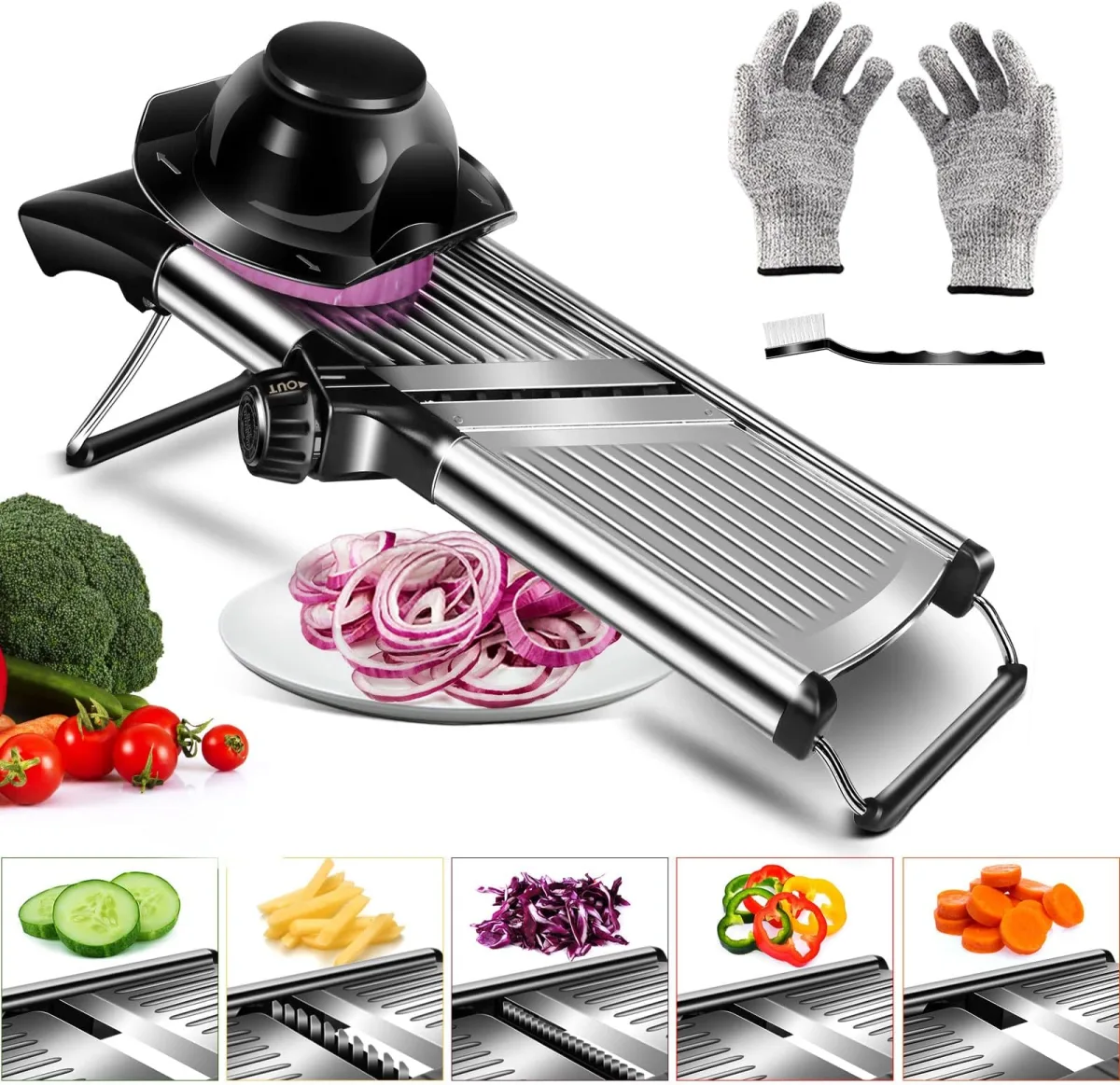
- Blade attachments: Some mandolines come with interchangeable blades for different cuts:
- Straight blade: For standard slices (e.g., potatoes, cucumbers).
- Julienne blade: For matchstick cuts (e.g., carrots, zucchini).
- Waffle blade: For crinkle cuts (e.g., potatoes for chips).
- Ridged blade: For decorative cuts (e.g., garnishes).
If your kitchen does a lot of different cuts, interchangeable blades can be a game-changer. Just make sure they’re easy to swap out-if it takes 10 minutes to change the blade, you’re not saving any time.
- Thickness range: As mentioned earlier, look for a mandoline that excels in the 1mm to 5mm range. If you need ultra-thin slices (e.g., for chips or garnishes), make sure the mandoline can handle that without tearing the ingredient.
- Ingredient compatibility: Some mandolines struggle with soft or delicate ingredients (like tomatoes or ripe avocados). If you’re slicing a lot of these, look for a mandoline with a gentler slicing action or a blade designed for soft ingredients.
- Size: Larger mandolines can handle bigger ingredients (like whole cabbages or large potatoes), but they’re also bulkier and harder to store. Smaller mandolines are more portable but may not be able to handle larger ingredients. Think about what you’ll be slicing most often and choose accordingly.
Here’s where I’m torn: do you go for a mandoline with all the bells and whistles, or do you stick with a simple, no-frills model? On one hand, a versatile mandoline can replace multiple tools in your kitchen, saving you space and money. On the other hand, more features often mean more things that can break or go wrong. Ultimately, it depends on your kitchen’s needs. If you’re doing a lot of specialty cuts (e.g., for a fine-dining restaurant), a versatile mandoline might be worth it. If you’re mostly slicing potatoes for fries, a simpler model will do the job just fine.
One thing I’ve learned: don’t assume you need every attachment under the sun. I’ve seen kitchens with mandolines that have 10 different blades, but they only ever use two. Start with the basics and add on as needed.
6. Speed vs. Precision: The Eternal Kitchen Dilemma
In a high-volume kitchen, speed is everything. But speed without precision is just a fast way to mess up a lot of ingredients. So, how do you strike the right balance? Here’s what to consider:
- Blade sharpness: A sharp blade slices faster and more precisely than a dull one. Look for a mandoline with a high-quality blade that stays sharp (see the blade material section above).
- Slicing action: Some mandolines have a smooth slicing action (like a knife gliding through butter), while others require more force. Smooth is better, it’s faster and more precise.
- Ingredient feed: Some mandolines have a wide feed chute that can accommodate larger ingredients, while others require you to cut ingredients into smaller pieces first. A wider feed chute can save you time, but it might not be as precise for smaller ingredients.
- Adjustability: A mandoline with a smooth, precise thickness dial will save you time in the long run. If you’re constantly fiddling with the dial to get the right thickness, you’re not saving any time.
Here’s the thing: speed and precision are often at odds. A mandoline that’s fast might not be as precise, and vice versa. The key is to find a mandoline that’s fast enough for your needs without sacrificing too much precision. For most high-volume kitchens, that means prioritizing speed but not at the expense of consistency.
I’ve worked in kitchens where the mandoline was so slow that cooks would rather use a knife. Don’t let that happen to you. Test the mandoline before buying (if possible) or read reviews from other high-volume kitchens to get a sense of its speed and precision.
7. Price: You Get What You Pay For (Most of the Time)
Let’s talk money. Mandolines range from $20 to $500+, and it’s tempting to go for the cheapest option. But here’s the hard truth: in a high-volume kitchen, a cheap mandoline is a false economy. It’ll break, dull, or become a safety hazard long before a more expensive model would. That said, you don’t need to spend a fortune to get a good mandoline. Here’s what to expect at different price points:
- $20–$50: These are the mandolines you find at big-box stores or on Amazon. They’re usually made of plastic, have dull blades, and lack safety features. Avoid them for high-volume use. They’re fine for home kitchens, but they won’t last in a professional setting.
- $50–$150: This is the sweet spot for most high-volume kitchens. You’ll find mandolines with stainless steel blades, durable housing, and decent safety features. Brands like OXO, Benriner, and Swissmar fall into this range. They’re not indestructible, but they’ll hold up to daily use.
- $150–$300: Here’s where you start to see pro-level features-Japanese steel blades, modular designs, and advanced safety features. Brands like Bron Coucke and De Buyer dominate this range. These are great for kitchens that do a lot of slicing or need ultra-precise cuts.
- $300+: Unless you’re running a Michelin-starred restaurant or a specialty production kitchen, you probably don’t need to spend this much. These mandolines are built for extreme durability and precision, but they’re overkill for most high-volume kitchens.
So, how much should you spend? Aim for the $100–$200 range. That’s where you’ll find the best balance of durability, safety, and performance. If you’re on a tight budget, you can find good options in the $50–$100 range, but be prepared to replace them more frequently.
One more thing: don’t forget to factor in the cost of replacement blades. Some mandolines have blades that can be sharpened, while others need to be replaced entirely. If you’re going through a lot of blades, a mandoline with replaceable blades might save you money in the long run.
8. Brand Reputation: Who Can You Trust?
Not all mandoline brands are created equal. Some have been around for decades and have a reputation for quality, while others are fly-by-night operations selling cheap knockoffs. Here are a few brands to consider (and a few to avoid):
Brands to Trust:
- Bron Coucke: A French brand known for its high-quality stainless steel blades and durable construction. Their mandolines are a favorite in professional kitchens, though they’re on the pricier side.
- De Buyer: Another French brand with a reputation for durability and precision. Their mandolines are built to last and are a great choice for high-volume kitchens.
- Benriner: A Japanese brand that’s been making mandolines for decades. Their mandolines are sharp, affordable, and reliable, though they lack some of the safety features of European brands.
- OXO: Known for their ergonomic designs and user-friendly features, OXO mandolines are a good choice for kitchens where safety and ease of use are priorities. They’re not as durable as Bron Coucke or De Buyer, but they’re more affordable.
- Swissmar: A Swiss brand that offers a good balance of quality and affordability. Their mandolines are well-built and come with a variety of blade attachments.
Brands to Avoid:
- No-name brands on Amazon: If the brand name is something like “KitchenPro” or “Chef’s Best,” it’s probably a cheap knockoff. These mandolines are often made with low-quality materials and lack safety features.
- Big-box store brands: Brands like Farberware or Hamilton Beach make decent home kitchen tools, but their mandolines aren’t built for high-volume use. They’ll break or dull quickly in a professional setting.
- Ceramic-blade mandolines: As mentioned earlier, ceramic blades are brittle and prone to breaking. Avoid them for high-volume use.
Pro tip: Check reviews from other professional kitchens. If a mandoline is getting rave reviews from chefs and prep cooks, it’s probably a good choice. If the reviews are mostly from home cooks, take them with a grain of salt.
9. Training Your Team: Because a Mandoline Is Only as Good as the Person Using It
You’ve invested in a top-of-the-line mandoline. Great! Now what? If your team doesn’t know how to use it safely and efficiently, it’s just an expensive paperweight. Here’s how to train your team:
- Start with safety:
- Demonstrate how to use the hand guard properly.
- Show them how to hold the ingredient (fingers curled under, away from the blade).
- Emphasize the importance of focus, no multitasking while using the mandoline.
- Teach proper technique:
- Use a smooth, controlled motion, no sawing back and forth.
- Don’t force the ingredient. If it’s not slicing easily, adjust the thickness or check the blade.
- For delicate ingredients (like tomatoes), use a gentler slicing action.
- Practice, practice, practice:
- Start with easy ingredients (like potatoes or carrots) before moving on to trickier ones (like onions or ripe avocados).
- Have your team practice adjusting the thickness dial to get a feel for it.
- Encourage them to ask questions, better to ask now than to make a mistake mid-service.
- Create a cheat sheet:
- Post a quick-reference guide near the mandoline station with safety tips, proper technique, and troubleshooting advice.
- Include a list of ingredients that are safe (and unsafe) to slice on the mandoline.
- Lead by example:
- If you’re the chef or kitchen manager, use the mandoline yourself to show your team that it’s a valuable tool, not just another gadget.
- Praise cooks who use it correctly and safely, positive reinforcement goes a long way.
I’ll be honest: training your team to use a mandoline properly takes time. There will be mistakes, there will be frustration, and there might even be a few near-misses. But once your team gets the hang of it, you’ll wonder how you ever lived without it. The key is to be patient and persistent. Don’t let your team give up on it after one bad experience.
One more thing: assign a “mandoline captain”. This is the person on your team who’s responsible for making sure the mandoline is used safely and correctly. They should be someone who’s comfortable with the tool and can troubleshoot issues as they arise. This takes some of the pressure off you and ensures that the mandoline is always in good hands.
10. Maintenance: Keeping Your Mandoline in Top Shape
A mandoline is like any other tool in your kitchen, it needs regular maintenance to perform at its best. Here’s how to keep yours in top shape:
- Clean it after every use:
- Disassemble it (if possible) and wash all parts thoroughly.
- Use a brush to remove any residue from the blade or housing.
- Dry it completely before storing to prevent rust or corrosion.
- Sharpen the blade regularly:
- Some mandolines have blades that can be sharpened, while others need to be replaced. Check the manufacturer’s instructions.
- If the blade is sharpenable, use a whetstone or honing rod to keep it sharp. A dull blade is a dangerous blade.
- If the blade needs to be replaced, order a new one before the old one gets too dull. A dull blade can tear ingredients and increase the risk of injury.
- Inspect it for damage:
- Check the housing for cracks or warping.
- Inspect the blade for chips or nicks.
- Make sure all parts are securely fastened.
- Store it properly:
- Store it in a dry, cool place to prevent rust or corrosion.
- If it has a blade cover, use it to protect the blade and prevent accidents.
- Keep it in a place where it won’t get bumped or damaged.
- Replace worn-out parts:
- If the hand guard is cracked or the thickness dial is stripped, replace them before they become a safety hazard.
- If the blade is beyond sharpening, order a new one.
Here’s a hard truth: o mandoline lasts forever. Even the best ones will eventually wear out. But with proper maintenance, you can extend its lifespan and keep it performing at its best for as long as possible. Think of it like a car, if you take care of it, it’ll take care of you.
I’ve seen kitchens where the mandoline is treated like a disposable tool, used until it breaks, then tossed in the trash. Don’t be that kitchen. A little maintenance goes a long way.
Putting It All Together: How to Choose the Right Mandoline for Your Kitchen
So, you’ve made it this far. You know about blade materials, build quality, safety features, and all the other factors that go into choosing a mandoline for a high-volume kitchen. But how do you put it all together and make the final decision? Here’s a step-by-step guide:
- Assess your needs:
- What ingredients will you be slicing most often? (e.g., potatoes, onions, carrots, tomatoes)
- What cuts do you need? (e.g., julienne, waffle, straight slices)
- How much volume will you be slicing? (e.g., 10 pounds of potatoes a day vs. 50 pounds)
- What’s your budget?
- Prioritize your must-haves:
- For example, if safety is your top priority, look for a mandoline with a high-quality hand guard and blade cover.
- If versatility is key, look for one with interchangeable blades.
- If durability is your main concern, focus on stainless steel housing and high-carbon steel blades.
- Narrow down your options:
- Based on your needs and priorities, create a shortlist of mandolines that fit the bill.
- Read reviews from other professional kitchens to get a sense of real-world performance.
- Test it out (if possible):
- If you can, try the mandoline before buying. Test the blade sharpness, slicing action, and adjustability.
- If you can’t test it in person, look for videos or demos online.
- Make the final decision:
- Weigh the pros and cons of each option on your shortlist.
- Consider the long-term costs (e.g., replacement blades, maintenance).
- Choose the mandoline that best fits your needs, budget, and priorities.
- Train your team:
- Once you’ve made your choice, train your team on how to use the mandoline safely and efficiently.
- Create a cheat sheet and assign a “mandoline captain” to oversee its use.
- Maintain it properly:
- Clean it after every use, sharpen the blade regularly, and inspect it for damage.
- Replace worn-out parts before they become a safety hazard.
Here’s the thing: there’s no one-size-fits-all answer. The best mandoline for your kitchen depends on your specific needs, budget, and priorities. But if you follow this guide, you’ll be well on your way to finding the perfect mandoline for your high-volume kitchen.
And remember: a mandoline is an investment. It’s not just a tool, it’s a way to save time, improve efficiency, and reduce the risk of injury in your kitchen. So, take your time, do your research, and choose wisely. Your future self (and your prep cook) will thank you.
Final Thoughts: The Mandoline That Changed My Kitchen
Looking back, I can pinpoint the exact moment my kitchen’s efficiency transformed. It wasn’t when we got the new combi oven or the high-speed blender, it was when we finally invested in a Bron Coucke mandoline. I’ll admit, I was skeptical at first. It was expensive, and I wasn’t sure it would live up to the hype. But within a week, it had paid for itself in saved time and reduced waste.
Here’s what I learned: the right mandoline doesn’t just slice ingredients, it slices through inefficiency. It turns a tedious, time-consuming task into something quick and effortless. It reduces the risk of injury and frees up your team to focus on more important things. And, perhaps most importantly, it makes your kitchen run smoother, which means less stress, fewer mistakes, and happier customers.
But here’s the catch: it has to be the right mandoline for your kitchen. The Bron Coucke worked for us because we needed durability, precision, and versatility. It might not be the right choice for every kitchen. That’s why it’s so important to do your research and choose a mandoline that fits your specific needs.
So, what’s the takeaway? If you’re running a high-volume kitchen and you’re still relying on knives for slicing, it’s time to make a change. Invest in a good mandoline, train your team, and maintain it properly. It might seem like a small thing, but it can make a big difference in your kitchen’s efficiency, and your sanity.
Now, I’m curious: what’s the biggest slicing challenge in your kitchen? Are you struggling with consistency, speed, or safety? Or maybe you’ve already found the perfect mandoline and want to share your experience. Either way, drop a comment below, I’d love to hear from you.
FAQ: Your Mandoline Questions, Answered
Q: Can I use a home kitchen mandoline in a high-volume setting?
A: Technically, yes, but you’ll regret it. Home kitchen mandolines are designed for occasional use, not the daily grind of a professional kitchen. They’ll dull quickly, break easily, and lack the safety features needed for high-volume slicing. Save yourself the headache and invest in a mandoline built for commercial use.
Q: How often should I sharpen or replace the blade?
A: It depends on how much you use it and what you’re slicing. For most high-volume kitchens, you’ll need to sharpen the blade every 1–2 weeks and replace it every 3–6 months. If you’re slicing abrasive ingredients (like potatoes or onions), you might need to sharpen or replace it more often. Keep an eye on the blade’s performance, if it’s tearing ingredients or requiring more force to slice, it’s time for a sharpening or replacement.
Q: What’s the safest way to use a mandoline?
A: Safety first! Here’s the safest way to use a mandoline:
- Always use the hand guard, no exceptions.
- Keep your fingers curled under and away from the blade.
- Use a smooth, controlled motion, no sawing back and forth.
- Don’t force the ingredient. If it’s not slicing easily, adjust the thickness or check the blade.
- Never use the mandoline while distracted. Focus on the task at hand.
- Store the mandoline with the blade covered when not in use.
And remember: if you’re not comfortable using the mandoline, don’t use it. There’s no shame in sticking with a knife if it’s safer for you.
Q: Are there any ingredients I shouldn’t slice on a mandoline?
A: Great question! While mandolines are incredibly versatile, there are a few ingredients you should avoid slicing on them:
- Frozen ingredients: Slicing frozen food can damage the blade and increase the risk of injury.
- Bones or hard pits: This one’s obvious, but it bears repeating, mandolines are for soft ingredients, not bones or pits.
- Very soft or mushy ingredients: Ingredients like overripe tomatoes or avocados can turn into a pulpy mess on a mandoline. If you must slice them, use a very sharp blade and a gentle slicing action.
- Sticky or gummy ingredients: Ingredients like mozzarella cheese or certain types of dough can gum up the blade and make slicing difficult. If you’re slicing these, clean the blade frequently to prevent buildup.
When in doubt, test a small piece of the ingredient first to see how it slices. Better safe than sorry!
@article{how-to-choose-a-mandoline-slicer-for-high-volume-kitchens-a-chefs-no-nonsense-guide,
    title   = {How to Choose a Mandoline Slicer for High-Volume Kitchens: A Chef’s No-Nonsense Guide},
    author  = {Chef's icon},
    year    = {2026},
    journal = {Chef's Icon},
    url     = {https://chefsicon.com/how-to-choose-mandoline-slicer-for-high-volume-kitchens/}
}