The Best Fluffy Pancakes recipe you will fall in love with. Full of tips and tricks to help you make the best pancakes.
I’ll admit it, I used to think “sustainable commercial kitchen” was just a buzzword chefs and consultants tossed around to sound virtuous. That was until I toured a Nashville restaurant last year where the owner showed me their monthly utility bills. Or rather, the lack of them. Their energy-efficient setup and waste-reduction systems had slashed costs by 40% while actually improving kitchen workflow. That’s when it clicked: sustainability isn’t just about saving polar bears (though, hey, that’s nice too). It’s about saving money, boosting efficiency, and future-proofing your business in an industry where margins are tighter than a sous chef’s pants.
Now, I’m not suggesting you turn your kitchen into a zero-waste hippie commune overnight. But after digging into the data, and yeah, I’ve spent way too many late nights comparing HVAC specs and composting systems, I’ve realized that sustainable design isn’t an all-or-nothing proposition. It’s about smart choices that add up. Maybe you start with energy-efficient fryers that pay for themselves in a year. Or you redesign your layout to cut down on unnecessary foot traffic (and the carbon footprint that comes with it). Or, here’s a wild thought, you actually measure how much food you’re wasting instead of just sighing when you toss another bin of spoiled lettuce.
This isn’t a manifesto. It’s a practical guide for restaurant owners, chefs, and designers who want to build or retrofit a commercial kitchen that’s as kind to the planet as it is to their profit margins. We’ll cover everything from equipment selection to waste streams, with real-world examples and the occasional rant about why so many kitchens still treat sustainability like an afterthought. And because I’ve been there, staring at a quote for a $20,000 induction range wondering if it’s worth it, I’ll also talk about where to prioritize your budget and where you can afford to cut corners (spoiler: not on ventilation).
One last thing: I’m writing this from my home office in Nashville, where Luna the cat is currently judging my life choices from her perch on the windowsill. If I start rambling about the ethical implications of avocado toast, blame the caffeine. Let’s get into it.
The Hidden Costs of Ignoring Sustainability (And Why Your Bottom Line Should Care)
Here’s an uncomfortable truth: most commercial kitchens are energy hogs. The U.S. Environmental Protection Agency estimates that restaurants use five to seven times more energy per square foot than other commercial buildings. And that’s before we talk about water waste, food spoilage, or the fact that your walk-in fridge might be leaking refrigerant like a sieve. But here’s the kicker-inefficiency isn’t just bad for the planet; it’s bleeding your profits.
Let’s break it down:
- Energy costs: The average restaurant spends $3.50 per square foot on electricity annually. For a 2,000 sq. ft. kitchen, that’s $7,000-just on power. And if you’re still running old-school gas ranges or inefficient hoods? You’re likely paying 20-30% more than you need to.
- Water waste: A single leaky pre-rinse spray valve can waste 10,000 gallons of water per year. Multiply that by a dish pit that runs 24/7, and you’re basically flushing money down the drain (literally).
- Food waste: The Restaurant Food Waste & Sustainability Report found that restaurants throw away 4-10% of purchased food before it even reaches a plate. For a restaurant doing $1M in annual sales, that’s $40,000 to $100,000 in the trash. Every. Year.
- Regulatory risks: Cities like New York, San Francisco, and (yes) Nashville are tightening regulations on grease disposal, emissions, and single-use plastics. Non-compliance fines aren’t just annoying, they can shut you down.
So why aren’t more kitchens designed with sustainability in mind from the start? Partly because the upfront costs can feel daunting. But here’s the thing: the ROI on sustainable upgrades is often faster than you think. A high-efficiency fryer might cost 20% more upfront but could save you $1,200+ annually in energy costs. Over its 10-year lifespan, that’s $12,000 back in your pocket. And that’s before you factor in potential tax incentives or utility rebates (more on those later).
I’m not saying you need to overhaul your entire operation tomorrow. But if you’re designing a new kitchen or retrofitting an old one, ignoring sustainability is like leaving free money on the table. And in this industry, who can afford to do that?
Where to Start: The 80/20 Rule of Sustainable Kitchen Design
If you’re feeling overwhelmed, good. That means you’re paying attention. But here’s how to simplify: focus on the 20% of changes that’ll give you 80% of the impact. Based on the kitchens I’ve studied (and the spreadsheets I’ve tortured), these are the big leverage points:
- Energy-efficient cooking equipment (induction, combi ovens, high-efficiency fryers)
- Smart ventilation systems (demand-controlled hoods, heat recovery)
- Water-saving fixtures (low-flow pre-rinse sprayers, aerated faucets)
- Waste separation and composting (three-bin systems, on-site digesters)
- Refrigeration upgrades (ENERGY STAR units, door seals, anti-sweat controls)
Everything else? Important, but secondary. Master these five areas, and you’ll be ahead of 90% of commercial kitchens out there.
Equipment Selection: The Good, the Bad, and the Ugly (But Efficient)
Let’s talk about the heart of your kitchen: the equipment. This is where most of your energy (and money) gets burned, literally. The right choices here can cut your utility bills by 30% or more, but the wrong ones will haunt you like a ghost of bad Yelp reviews past.
Cooking Equipment: Gas vs. Electric vs. Induction
The great gas vs. electric debate isn’t just about cooking performance anymore, it’s about operational costs, emissions, and future-proofing. Here’s the breakdown:
Gas Ranges: The incumbent. Chefs love the control, but gas is a fossil fuel, and cities are starting to phase it out (looking at you, Berkeley and New York). If you’re stuck with gas (or love it too much to quit), at least opt for high-efficiency burners with electronic ignition (no pilot lights wasting gas 24/7). Brands like Vulcan and Garland offer models that are 30% more efficient than older units.
Electric Ranges: Better than gas for emissions, but still not the gold standard. Traditional electric coils are energy hogs. If you go electric, infrared or ceramic glass cooktops are slightly better, but honestly? They’re the participation trophy of sustainable cooking.
Induction Cooktops: The clear winner for efficiency and sustainability. Induction uses 90% of the energy it consumes to heat food, compared to ~40% for gas. It’s also safer (no open flames), cooler (less AC load), and, bonus, easier to clean. The catch? Upfront costs are higher, and you’ll need magnetic cookware (which, fine, is a one-time investment). Brands like Miele and BlueStar make commercial-grade induction ranges that’ll last decades. Pro tip: Some utility companies offer rebates for induction upgrades. Check with your local provider.
I’ll be honest, I was skeptical about induction until I watched a line cook sear scallops on one during a lunch rush. The precision was insane. And when the chef told me their gas bill had dropped by $800/month after switching? I became a convert.
Ovens: Combi vs. Convection vs. Pizza Ovens
Ovens are another major energy suck. Here’s how to choose:
- Combi Ovens: The Swiss Army knife of commercial ovens. They combine steam, convection, and (in some models) microwave energy to cook faster and more efficiently. A good combi like the Rational SelfCookingCenter can replace a steamer, convection oven, and proofing cabinet, saving space and energy. Look for models with energy recovery systems that reuse heat from the exhaust.
- Convection Ovens: More efficient than standard ovens but still not as versatile as combis. If you’re stuck with convection, opt for high-speed models that cook faster (less energy per batch). Blodgett and Bakers Pride make solid commercial units with good insulation.
- Pizza Ovens: Wood-fired is romantic but terrible for emissions and efficiency. If you must have that Neapolitan vibe, consider a hybrid oven like the Marsal, which uses less wood and has better heat retention. For high-volume pizzerias, electric deck ovens (like Baker’s Pride) are the sustainable choice.
One thing I’ve noticed: a lot of chefs resist combi ovens because they’re “not traditional.” But after working with a few who’ve made the switch, the consensus is clear: they save time, reduce waste, and cut energy use by up to 50%. And in a commercial kitchen, tradition doesn’t pay the bills.
Fryers: The Silent Energy Vampires
Fryers are one of the biggest energy hogs in a commercial kitchen. A standard open-vat fryer can consume 1,800 watts per hour, and if it’s not properly insulated, it’s leaking heat (and money) constantly. Here’s how to upgrade:
- High-Efficiency Fryers: Look for models with insulated cabinets, fast recovery times, and programmable idle modes. Pitco and Frymaster make ENERGY STAR-certified fryers that use 30-40% less energy than older models.
- Filtration Systems: Extending oil life isn’t just about food quality, it’s about reducing waste and disposal costs. A system like Oil Matic can double or triple your oil’s lifespan, cutting your oil purchases (and environmental impact) in half.
- Alternative Frying Methods: Air fryers aren’t just for home kitchens anymore. Commercial models like the Henny Penny Evolution Elite use 80% less oil and can handle everything from wings to tempura. They’re not a 1:1 replacement for deep fryers, but for certain menu items, they’re a game-changer.
I once worked with a burger joint that switched to high-efficiency fryers and an oil filtration system. Their oil costs dropped by $12,000/year, and their energy bill went down by 15%. The fryers paid for themselves in less than two years. Not bad for a “small” upgrade.
Ventilation: The Invisible Energy Drain (And How to Fix It)
Here’s a fun fact: kitchen hoods and ventilation systems can account for up to 50% of a restaurant’s energy use. Fift. Percent. That’s more than your ovens, fryers, and refrigeration combined in some cases. And yet, most kitchen designers treat ventilation as an afterthought, something to slap in at the end to meet code.
Big mistake. A well-designed ventilation system doesn’t just remove smoke and grease; it saves energy, improves air quality, and reduces fire risks. Here’s how to get it right:
Demand-Controlled Ventilation (DCV)
Traditional hoods run at full blast 24/7, even when the kitchen is empty. Demand-controlled ventilation uses sensors to adjust airflow based on actual cooking activity. When the griddle’s off, the hood slows down. When you fire up the charbroiler, it ramps up. The result? Energy savings of 30-60%.
Brands like Halton and Greenheck make DCV systems that integrate with your existing hoods. The upfront cost is higher, but the payback period is usually 2-4 years. And if you’re in a city with strict emissions regulations (looking at you, California), DCV might soon be required.
Heat Recovery Systems
Here’s a crazy idea: instead of blasting all that hot, greasy air outside, why not recapture the heat and use it to warm your water or preheat incoming air? That’s exactly what a heat recovery ventilator (HRV) does. In colder climates, an HRV can reduce heating costs by 20-40% by recycling waste heat from the kitchen.
I toured a brewery in Denver that installed an HRV system, and their winter gas bills dropped by $3,000/month. The system paid for itself in 18 months. If you’re in a region with extreme temperatures, this is a no-brainer.
Hood Design: Size Matters (But Bigger Isn’t Better)
There’s a myth that bigger hoods are always better. Reality? Oversized hoods waste energy by pulling more air than necessary. The key is to right-size your hoods based on your equipment and cooking volume. Here’s how:
- Match the hood width to your cooking equipment (e.g., a 4-foot hood for a 4-foot range).
- Opt for low-profile hoods if you have space constraints, they’re more efficient than traditional canopy hoods.
- Consider island hoods for open kitchens (they’re designed to capture smoke and heat from all sides).
- Use grease extraction filters to reduce duct cleaning frequency (and fire risks).
And for the love of all that is holy, don’t skimp on ductwork. Poorly designed ducts create backpressure, forcing your hood fans to work harder (and use more energy). A good rule of thumb: shorter, straighter ducts with minimal bends.
Refrigeration: The Cold, Hard Truth About Energy Waste
Walk-in coolers and freezers are the silent killers of your energy budget. They run 24/7, and if they’re not properly maintained, they’re leaking money like a broken ice machine. Here’s how to keep them efficient:
ENERGY STAR-Certified Units
If you’re buying new refrigeration, ENERGY STAR certification is non-negotiable. These units use 20-40% less energy than standard models. Brands like True Manufacturing and Traulsen make commercial-grade ENERGY STAR coolers and freezers that’ll last for decades.
But here’s the thing: even the best unit won’t save energy if it’s not properly maintained. Which brings us to…
Door Seals and Anti-Sweat Controls
A worn door seal can increase energy use by 25%. Check your seals quarterly and replace them if they’re cracked or brittle. And if your cooler has anti-sweat door heaters, make sure they’re working correctly. These heaters prevent condensation but can add 5-10% to your energy use if they’re not calibrated properly.
Pro tip: Install strip curtains on walk-in coolers. They reduce cold air loss by up to 70% every time the door opens. For a busy kitchen, that can mean hundreds of dollars in savings per year.
Defrost Systems: Manual vs. Automatic
Frost buildup forces your compressor to work harder, which wastes energy. If your freezer still requires manual defrosting, you’re living in the Stone Age. Modern units have automatic defrost cycles that run during off-peak hours. Some even use hot gas defrost, which is more efficient than electric resistance defrosting.
If you’re retrofitting an older unit, consider adding a defrost timer or upgrading to a demand-defrost system that only activates when needed.
Refrigerant Choices: The R-22 Phase-Out and What It Means for You
If your cooler is more than 10 years old, it might still be using R-22 refrigerant, which is being phased out due to its ozone-depleting properties. As of 2025, R-22 is banned for new equipment, and supplies are dwindling. If your unit springs a leak, you could be facing a $10,000+ recharge (if you can even find the refrigerant).
The solution? Upgrade to a unit using R-290 (propane) or R-600a (isobutane). These natural refrigerants have ear-zero global warming potential and are already standard in Europe. Brands like Sandeen and Hoshizaki offer R-290 models that are just as reliable as traditional units.
Water Efficiency: Because Every Drop Counts (Literally)
Water is the most underestimated utility in commercial kitchens. We focus on energy costs, but water and sewer bills add up fast, especially in drought-prone areas. Here’s how to cut usage without sacrificing cleanliness or efficiency:
Pre-Rinse Spray Valves: The Low-Hanging Fruit
A standard pre-rinse spray valve uses 3-5 gallons per minute (GPM). A low-flow model (like those from T&S Brass) uses 1.28 GPM or less-and gets dishes just as clean. At $0.01 per gallon, that’s a savings of $1,000+ per year for a busy dish pit.
But here’s the kicker: most low-flow valves pay for themselves in under a year. If you’re not using them, you’re basically throwing money away.
Dishwashers: High-Temp vs. Low-Temp
The great dishwasher debate: high-temp vs. low-temp. Here’s the breakdown:
- High-Temp Dishwashers: Use 180°F water to sanitize dishes. They’re fast and effective but require a booster heater, which adds to energy costs.
- Low-Temp Dishwashers: Use chemical sanitizers instead of heat. They’re more water-efficient but require careful chemical management (and some chefs swear they don’t get dishes as clean).
So which is more sustainable? It depends. If your kitchen has waste heat recovery, a high-temp machine might be more efficient overall. If not, a low-temp model with a water recirculation system (like the Hobart AM15) could save thousands of gallons per year.
One thing’s for sure: ever run a half-load. Wait until the rack is full to maximize water and energy efficiency.
Ice Machines: The Hidden Water Wasters
Ice machines are otorious water hogs. A standard cube ice machine can use 200-400 gallons of water per 100 pounds of ice. That’s because most of the water goes down the drain during the harvest cycle.
The fix? Air-cooled, water-efficient models. Look for machines with:
- Closed-loop water systems (reuse water for multiple cycles)
- Energy Star certification (uses at least 15% less energy and water)
- Automatic shutoff when the bin is full
Brands like Manitowoc and Scotsman make commercial ice machines that produce the same amount of ice with half the water waste. And if you’re in a hot climate, opt for an air-cooled model, water-cooled units are extremely inefficient unless you’re recirculating the water.
Waste Management: From Trash to Treasure (Or at Least, Less Trash)
Food waste is the elephant in the kitchen. The average restaurant throws away 100,000 pounds of food per year. That’s not just a moral issue, it’s a $160 billion problem for the industry. Here’s how to tackle it:
The Three-Bin System: Recycle, Compost, Landfill
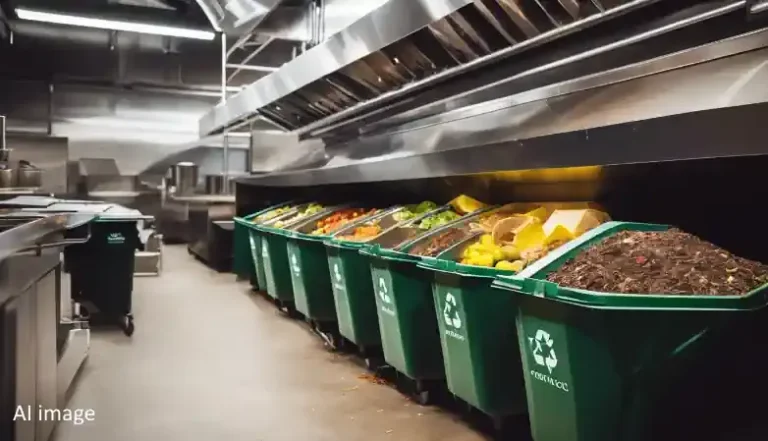
If your kitchen still has a single trash can, you’re doing it wrong. A three-bin system (recycling, compost, landfill) is the minimum viable setup. But to make it work, you need:
- Clear labeling (with pictures, yes, even your line cooks need visual aids)
- Convenient placement (bins should be within arm’s reach of prep stations)
- Staff training (hold a 10-minute meeting to explain what goes where)
I’ve seen kitchens reduce landfill waste by 70% just by implementing this system. And in cities with composting mandates (like Seattle or San Francisco), it’s not optional, it’s the law.
On-Site Composting and Food Waste Digesters
If you’re generating a lot of food waste (looking at you, veggie prep stations), an on-site composting system can turn scraps into nutrient-rich soil in 24 hours. Brands like EarthCube and Lomi make commercial composters that fit under a counter.
For larger operations, a food waste digester (like the BioHitech Eco-Safe) breaks down food waste into liquid that can go down the drain (check local regulations first). These systems can reduce waste volume by 80-90%, cutting your hauling costs dramatically.
Yes, they’re an investment-$5,000 to $20,000 depending on size. But if you’re paying $500/month for waste removal, the math starts to make sense fast.
Inventory Management: The Best Waste Reduction Tool
Here’s a radical idea: stop over-ordering food. I know, I know, every chef has a horror story about running out of avocados during brunch. But food waste isn’t just about scraps; it’s about spoilage from poor inventory control.
Solutions:
- First In, First Out (FIFO): Train your staff to rotate stock properly.
- Portion control: Use scales and portion scoops to avoid over-serving.
- Tech tools: Apps like Toast or MarketMan track inventory in real-time and alert you before items spoil.
- Menu engineering: Design dishes around ingredients with similar shelf lives to reduce waste.
A restaurant I consulted with in Austin cut their food waste by 40% just by implementing FIFO and better portioning. Their food cost percentage dropped from 32% to 28%-a $40,000 annual savings.
Lighting: Because Even Kitchens Need to See the Light
Lighting is the lowest-hanging fruit in sustainable kitchen design. Swapping out old bulbs for LEDs can cut your lighting energy use by 75% with minimal upfront cost.
LED vs. Fluorescent vs. Incandescent
If you’re still using incandescent bulbs, I don’t know what to tell you. Even fluorescent tubes are on their way out (they contain mercury and flicker like a horror movie set). LEDs are the only sensible choice:
- Use 75% less energy than incandescent
- Last 25 times longer (50,000 hours vs. 2,000)
- Emit less heat, reducing AC load
- Instant-on (no warm-up time like fluorescents)
For task lighting (like over prep stations), go with high-CRI LEDs (Color Rendering Index of 90+). They make food look better and reduce eye strain. Brands like Cree and Philips make commercial-grade LED tubes and bulbs that fit standard fixtures.
Motion Sensors and Dimmers
Why light an empty kitchen? Motion sensors in walk-ins, dry storage, and restrooms ensure lights are only on when needed. And in dining areas, dimmable LEDs let you adjust ambiance while saving energy.
A word of caution: ot all LEDs are dimmable. Check the spec sheet before buying, or you’ll end up with a strobe-light effect that’ll give your guests seizures.
Materials and Finishes: What’s Underfoot (And on the Walls) Matters
The materials you choose for floors, walls, and countertops impact durability, cleanability, and sustainability. Here’s how to pick wisely:
Flooring: Slip-Resistant and Sustainable
Commercial kitchen floors take a beating. They need to be slip-resistant, durable, and easy to clean. But they can also be sustainable:
- Recycled Rubber Flooring: Made from old tires, it’s slip-resistant, comfortable to stand on, and 100% recyclable. Brands like Mondial and Roppe make commercial-grade rubber flooring that lasts decades.
- Polished Concrete: If you have a concrete subfloor, polishing it (instead of covering it) creates a durable, low-maintenance surface. It’s also thermally efficient, helping regulate kitchen temps.
- Bamboo or Cork: For dry areas (like manager offices), these renewable materials add warmth and are aturally antimicrobial.
Avoid vinyl if possible, it’s not recyclable and off-gases VOCs. If you must use it, look for phthalate-free, recycled-content vinyl.
Countertops: Durable and Non-Toxic
Stainless steel is the gold standard for commercial kitchens, but it’s not the only option:
- Stainless Steel: Recyclable, durable, and easy to sanitize. Opt for 304-grade (18/8 chromium/nickel) for maximum corrosion resistance.
- Recycled Paper Composite: Brands like PaperStone make countertops from 100% post-consumer paper and resin. They’re heat-resistant, non-toxic, and surprisingly durable.
- Quartz: If you want a stone look, choose quartz with recycled content (like Cambria’s Brittanicca). Avoid granite, it’s porous and requires toxic sealants.
Wall Finishes: Easy to Clean, Hard to Stain
Walls need to withstand grease, steam, and constant cleaning. Skip the paint, it peels. Instead, consider:
- Stainless Steel Panels: Easy to clean, reflective (helps with lighting), and recyclable.
- Fiberglass Reinforced Plastic (FRP): Lightweight, mold-resistant, and available in recycled options.
- Ceramic Tile: Choose large-format tiles to minimize grout lines (which harbor bacteria). Opt for recycled-content tile and non-toxic grout.
The Human Factor: Training Staff for Sustainable Success
You can design the most sustainable kitchen in the world, but if your staff doesn’t buy in, it’s all for nothing. Training is the secret sauce (pun intended).
Make Sustainability Part of Onboarding
New hires should learn your waste sorting system, energy-saving protocols, and water conservation practices on day one. Make it part of the standard onboarding checklist. And yes, quiz them. If they can’t tell the difference between compost and recycling, they’re not ready for the line.
Incentivize Green Behavior
People respond to incentives. Try:
- Bonus for lowest waste shift: Track food waste by shift and reward the team that wastes the least.
- Energy-saving challenges: See which line cook can prep their station using the least water or electricity.
- Recognition: Shout out “eco-champions” in staff meetings or on a bulletin board.
A café in Portland gamified their composting system with a leaderboard. Within a month, their landfill waste dropped by 60%.
Lead by Example
If the chef is tossing plastic gloves in the trash instead of the recycling bin, guess what? The staff will too. Managers and chefs must model sustainable behaviors-whether it’s turning off idle equipment, using reusable towels instead of paper, or properly sorting waste.
And if you hear “But we’ve always done it this way,” push back. The restaurant industry is changing, and sustainability is no longer optional, it’s a competitive advantage.
Budgeting for Sustainability: Where to Splurge and Where to Save
Let’s talk money. Sustainable upgrades can be expensive, but not all of them. Here’s how to prioritize your spending:
Splurge-Worthy Investments (High ROI)
- Induction cooktops: Pay for themselves in 2-5 years via energy savings.
- Demand-controlled ventilation: Saves 30-60% on HVAC costs.
- ENERGY STAR refrigeration: Cuts energy use by 40% and lasts longer.
- On-site composting/digester: Reduces hauling costs by 80%+.
Mid-Tier Upgrades (Moderate Cost, Solid Savings)
- LED lighting: Pays back in under 2 years.
- Low-flow pre-rinse sprayers: $50 upgrade, saves $1,000+/year.
- Strip curtains for walk-ins: $200 install, saves hundreds annually.
- Inventory management software: Reduces food waste by 20-30%.
Low-Cost/No-Cost Changes (Do These Tomorrow)
- Train staff on waste sorting.
- Switch to reusable rags instead of paper towels.
- Implement FIFO inventory.
- Set thermostats 2°F higher in summer, 2°F lower in winter.
- Turn off idle equipment (like holding cabinets when not in use).
And don’t forget to check for rebates. Utility companies, local governments, and even equipment manufacturers offer incentives for sustainable upgrades. The Database of State Incentives for Renewables & Efficiency (DSIRE) is a great place to start.
Case Studies: Real Kitchens, Real Savings
Let’s look at a few real-world examples to see how these principles play out:
The Zero-Waste Bakery: Nashville, TN
A local bakery, Dough & Co., wanted to eliminate landfill waste. They implemented:
- A three-bin waste system (compost, recycling, landfill)
- An on-site composting machine for food scraps
- Reusable packaging for bread and pastries
- Bulk ingredient purchasing to reduce packaging waste
Results: They diverted 98% of waste from landfills and saved $8,000/year in trash hauling fees. Plus, their “zero-waste” branding attracted eco-conscious customers, boosting sales by 15%.
The Energy-Efficient Brewery: Denver, CO
A craft brewery, Peak View Brewing, retrofitted their kitchen with:
- Induction brew kettles (replaced propane)
- A heat recovery ventilator to preheat incoming air
- LED lighting with motion sensors
- A closed-loop water system for cooling
Results: Their energy bills dropped by 40%, saving $24,000/year. The induction kettles also improved temperature control, leading to more consistent batches.
The Fast-Casual Chain: National Rollout
A regional fast-casual chain with 50 locations switched to:
- High-efficiency fryers with oil filtration
- Demand-controlled ventilation in all new locations
- Compostable packaging (where municipally compostable)
- Staff training on waste reduction
Results: Across 50 locations, they saved $1.2 million annually in energy, water, and waste costs. Their oil usage dropped by 50%, and customer satisfaction scores rose due to the “eco-friendly” branding.
The Future of Sustainable Kitchens: Trends to Watch
Sustainable kitchen design is evolving fast. Here are a few trends that could reshape the industry in the next 5-10 years:
AI and IoT for Energy Optimization
Smart kitchens are coming. Imagine:
- Hoods that adjust airflow based on real-time air quality sensors.
- Refrigerators that auto-defrost only when needed and alert you to temperature fluctuations.
- Ovens that optimize cook times based on humidity and altitude.
Companies like Samsung SmartThings and IBM’s Watson IoT are already developing commercial kitchen applications. The upfront cost is high, but the potential savings are massive.
Circular Economy Kitchens
The next frontier is closed-loop systems, where waste becomes a resource. Examples:
- Biogas digesters that turn food waste into cooking fuel.
- Greywater systems that recycle sink water for irrigation or toilet flushing.
- 3D-printed utensils made from compostable materials.
A restaurant in Sweden, Spill, already uses a biogas system to power its stoves with food waste. It’s not mainstream yet, but watch this space.
Carbon-Neutral Certifications
Customers increasingly care about carbon footprints. Certifications like Carbon Neutral Restaurant (from Zero Foodprint) or Green Restaurant Certification (from the Green Restaurant Association) are becoming marketing assets. Expect more kitchens to pursue these in the next few years.
Plant-Based and Lab-Grown Foods
The rise of plant-based meats and lab-grown proteins will change kitchen design. These foods often require different prep equipment (e.g., high-shear mixers for plant-based burgers) and have lower cooking temps (reducing energy use). Kitchens that adapt early will have a competitive edge.
Common Mistakes (And How to Avoid Them)
Even with the best intentions, it’s easy to mess up. Here are the pitfalls I see most often:
Overestimating Your Needs
Bigger isn’t always better. A massive walk-in cooler might seem impressive, but if it’s half-empty, you’re paying to cool air. Same goes for oversized hoods or excessive prep space. Right-size everything based on your actual volume.
Ignoring Maintenance
A high-efficiency fryer won’t stay efficient if the filters are clogged. A preventive maintenance plan is essential. Schedule:
- Quarterly hood cleaning
- Monthly refrigerator coil cleaning
- Weekly grease trap pumping
- Daily equipment checks (e.g., fryer oil levels, walk-in door seals)
Skipping the Energy Audit
You wouldn’t design a menu without tasting the dishes, right? So why design a kitchen without an energy audit? Many utility companies offer free or subsidized audits that identify inefficiencies. It’s the best way to prioritize upgrades.
Forgetting About the Front of House
Sustainability isn’t just a back-of-house issue. Front-of-house choices-like disposable vs. reusable tableware, water service policies, and even the type of napkins you use, impact your overall footprint. A truly sustainable kitchen considers the entire operation.
Final Thoughts: Sustainability as a Competitive Advantage
Here’s the thing about sustainable kitchen design: it’s not just about doing less harm. It’s about doing more good, for your business, your staff, and your customers.
The restaurants and foodservice operations that thrive in the next decade won’t just be the ones with the best food or the trendiest decor. They’ll be the ones that operate efficiently, waste less, and align with their customers’ values. Millennials and Gen Z, who now make up the majority of diners-care about sustainability. A 2024 study by the National Restaurant Association found that 68% of consumers are more likely to choose a restaurant with sustainable practices.
But here’s the kicker: you don’t have to be perfect. You just have to be better than yesterday. Start small. Pick one area, maybe it’s switching to LED lighting or training your staff on waste sorting, and build from there. Measure your progress. Celebrate the wins. And remember: every kilowatt-hour saved, every gallon of water conserved, every pound of food waste diverted is money back in your pocket.
So, what’s your first move? Maybe it’s scheduling that energy audit. Or swapping out one old fryer for a high-efficiency model. Or just having a conversation with your team about where you’re wasting the most. Whatever it is, start today. Because the best time to design a sustainable kitchen was 10 years ago. The second-best time? Right now.
And if you need me, I’ll be in my home office, arguing with Luna about whether composting cat litter counts as sustainable. (Spoiler: It doesn’t. But a guy can dream.)
FAQ
Q: How much more does a sustainable commercial kitchen cost upfront?
A: It varies, but expect to pay 10-20% more for high-efficiency equipment and sustainable materials. However, the payback period is often 2-5 years thanks to utility savings and rebates. For example, an ENERGY STAR refrigerator might cost $1,000 more but save you $300/year in energy costs, so it pays for itself in about 3 years. Always run the numbers for your specific operation.
Q: What’s the single most impactful change I can make to reduce energy use?
A: If you had to pick just one thing, upgrade your cooking equipment to induction or high-efficiency models. Cooking equipment accounts for 35-40% of a commercial kitchen’s energy use, so improvements here have the biggest impact. Induction cooktops, in particular, can cut energy use by 50-70% compared to gas or traditional electric.
Q: Are there any tax incentives or rebates for sustainable kitchen upgrades?
A: Yes! The Inflation Reduction Act of 2022 extended tax credits for energy-efficient commercial buildings, including restaurants. You may qualify for:
- 179D Deduction: Up to $1.80/sq. ft. for energy-efficient building upgrades.
- 45L Credit: Up to $5,000 for energy-efficient new construction or retrofits.
- Utility Rebates: Many local utilities offer rebates for ENERGY STAR equipment, LED lighting, and high-efficiency HVAC. Check DSIRE for a database of incentives.
Always consult a tax professional to maximize your savings.
Q: How do I get my staff on board with sustainable practices?
A: Start with training and incentives. Make sustainability part of onboarding, and explain why it matters (e.g., “This composting system saves us $500/month, which means more money for bonuses”). Gamify it with challenges (e.g., “Which shift can reduce food waste the most this week?”). And lead by example, if the chef is sorting compost, the line cooks will too. Finally, listen to their feedback. They’re the ones using the systems daily, so they’ll have ideas for improvements.
@article{sustainable-commercial-kitchen-design-principles-how-to-build-a-kitchen-thats-good-for-business-and-the-planet,
    title   = {Sustainable Commercial Kitchen Design Principles: How to Build a Kitchen That’s Good for Business *and* the Planet},
    author  = {Chef's icon},
    year    = {2025},
    journal = {Chef's Icon},
    url     = {https://chefsicon.com/sustainable-commercial-kitchen-design-principles/}
}