The Best Fluffy Pancakes recipe you will fall in love with. Full of tips and tricks to help you make the best pancakes.
I’ll admit it, I used to baby my cast iron like it was a Fabergé egg. I’d read forum threads at 2 AM about flaxseed oil polymerization, stress over microscopic rust spots, and once (embarrassingly) seasoned a pan with avocado oil because some influencer swore it was “the secret.” Then Luna, my rescue cat, knocked said pan off the stove mid-seasoning, and I realized: I was making this way harder than it needed to be.
Here’s the thing: cast iron is the originalonstick, the workhorse of kitchens for centuries, and it thrives on use, not fuss. Yet somewhere between Instagram reels and grandma’s vague advice (“just don’t use soap!”), we’ve turned simple maintenance into a cult. This guide is my attempt to cut through the noise, part science, part hard-won lessons from ruining (and reviving) three skillets in one year. You’ll learn how to clean, season, store, and troubleshoot your cast iron without losing your mind. And yes, we’ll talk about soap. (Spoiler: You can use it.)
By the end, you’ll know:
- Why your pan’s “stickiness” might actually be user error (and how to fix it).
- The truth about high-heat cooking and why your stove’s “max” setting is lying to you.
- How to rescue a rusted, crusty pan that’s been abandoned in a garage since 1998.
- When to ignore “traditional” advice (looking at you, bacon grease seasoning).
Let’s start with the most controversial take: Cast iron is not fragile. It’s a chunk of iron. It can handle more than you think. What it can’t handle? Your anxiety.
-
The Brutal Honesty Guide to Cast Iron Maintenance (10 Things No One Tells You)
1. The Great Soap Debate: Why You’ve Been Misled (And How to Actually Clean Your Pan)
I get it, someone’s grandma probably whispered in your ear that soap would “ruin the seasoning.” Here’s the reality: Soap is fine. Modern dish soaps are mild compared to the lye-based monstrosities of the 1950s. The real enemy? Prolonged soaking and abrasive scrubbers. Soap won’t strip seasoning if you’re not letting your pan marinate in a Dawn bath for hours.
How to clean it right:
- While warm (not scorching): Fill the pan with hot water and use a wooden spatula or chainmail scrubber to loosen stuck-on bits. The heat helps release food, no elbow grease needed.
- Stubborn bits? Sprinkle kosher salt and scrub with a paper towel or soft brush. The salt acts as a gentle abrasive without damaging the seasoning.
- Soap? A drop of mild dish soap on a sponge is fine for greasy residue. Just rinse immediately and dry thoroughly.
- Never: Steel wool (unless you’re stripping the pan for a reset), or letting it air-dry (rust city).
Pro tip: If your pan smells like last night’s fish, boil water with a splash of vinegar in it for 5 minutes. Rinse, dry, and re-season lightly. Works like magic.
2. Seasoning Isn’t a One-Time Event, It’s a Relationship (And You’re Probably Cheating on It)
Seasoning is just baked-on oil that polymerizes into a slick, nonstick surface. But here’s where people mess up: They treat it like a finish line instead of an ongoing process. You wouldn’t wax your car once and expect it to stay shiny forever, right?
The truth about oils:
- Flaxseed oil: The darling of cast iron forums for its high drying capacity. Yes, it creates a hard seasoning, but it’s also finicky-too thick and it’ll pool; too thin and it won’t bond. I use it for initial seasoning, not maintenance.
- Crisco/vegetable shortening: The unsung hero. Cheap, stable, and leaves a smooth finish. My daily driver.
- Bacon grease: Stop. Just… stop. It’s delicious for cooking but terrible for seasoning-low smoke point, animal fats go rancid.
- Avocado/grapeseed oil: Overkill. Expensive and no better than Crisco for most uses.
How to season like a pro (not a perfectionist):
- Preheat oven to 450°F (232°C). Yes, higher than most guides say, we want full polymerization.
- Wipe pan with a thin layer of oil (use a paper towel until it looks dry). If it’s shiny, you’ve used too much.
- Bake upside down on the middle rack with a foil-lined tray below to catch drips. 1 hour.
- Turn off oven, let it cool inside (this prevents warping from rapid temp changes).
- Repeat 2-3 times for a new pan or reset. For maintenance? After every 3-5 uses, or when food starts sticking.
Is this the only way? No. Stovetop seasoning works too (heat pan until smoking, wipe oil, repeat). But oven method is foolproof. And no, you don’t need to season after every use, just when it needs it.
3. Rust Happens. Here’s How to Fix It Without Panic.
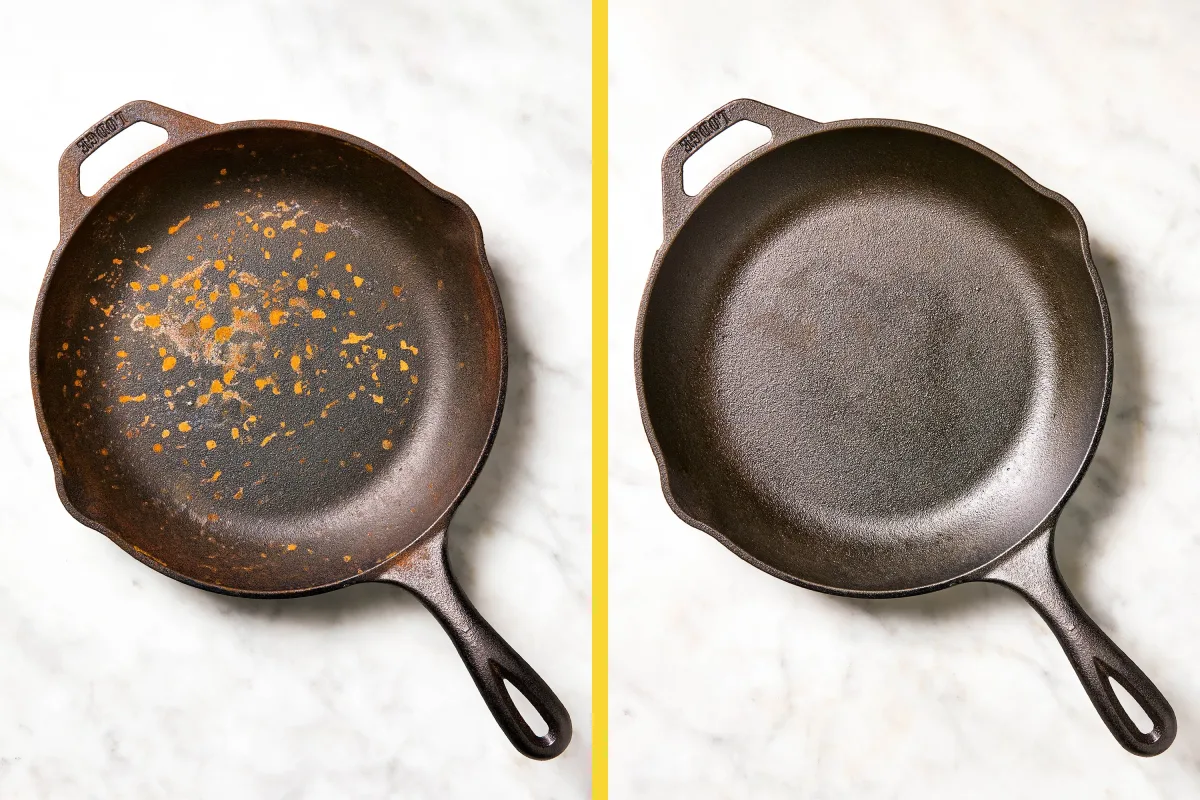
Found orange spots? Congrats, you’ve discovered iron oxide. It’s not the end of the world. Rust forms when moisture meets bare iron, usually from improper drying or storage. The fix is simpler than you think:
For light rust:
- Scrub with a stainless steel scrubber or salt + oil paste.
- Rinse, dry completely (see next section), and re-season.
For heavy rust (or a pan dug out of a garage):
- Soak in a 50/50 vinegar-water solution for 30–60 minutes. The acid dissolves rust.
- Scrub with steel wool or a drill-mounted wire brush (yes, really).
- Rinse, dry thoroughly, and season like it’s new.
Key insight: Rust is preventable. Store your pan in a dry place (not the dishwasher, not a damp cabinet). If you live in a humid climate, toss a silica gel packet in your pot drawer.
4. The Heat Myth: Why Your Stove Is Lying to You
Cast iron loves heat, but your stove’s “high” setting is probably too hot. Most electric coils and gas burners max out around 600–700°F, but cast iron retains heat like a champ. Cranking it to max warps the pan over time and burns off seasoning.
How to control heat like a pro:
- Preheat gradually: Start on medium, let it warm for 5–10 minutes. Cast iron is slow to heat but holds temp like a boss.
- Use the “water drop test”: Flick water on the pan. If it sizzles and evaporates instantly, it’s ready. If it beads and rolls, it’s too cold. If it smokes like a chimney, it’s too hot.
- Adjust as you cook: Cast iron stays hot. If your oil is smoking, turn it down. You’re not searing a steak at 700°F, you’re burning your seasoning.
Warped pan? Don’t toss it. Most warping is cosmetic. If it’s severe, you can flatten it by heating it on a grill or oven rack (weight helps) or taking it to a machine shop for milling. But honestly? A little warp won’t kill you.
5. The Stickiness Problem: Why Your Eggs Are Glued to the Pan (And It’s Not the Pan’s Fault)
If your cast iron is “sticky,” it’s usually one of three things:
- Too much oil in seasoning: Wipe it thin. If it’s glossy, you’ve overdone it.
- Cooking with the wrong oil: Butter and olive oil have low smoke points. Use refined coconut oil, avocado oil, or ghee for high-heat cooking.
- Food wasn’t dry or hot enough: Pat meat dry before searing. Let the pan preheat fully. Cold food + hot pan = sticking.
Test your seasoning: Fry an egg with a little oil. If it slides around like a hockey puck, you’re golden. If it sticks? Strip and re-season (see Section 7).
6. Storage: How to Keep Your Pan Happy Between Uses
Cast iron’s worst enemies: moisture and stacking. Here’s how to store it right:
Do:
- Store in a dry, ventilated place (not a sealed drawer).
- Stack with a towel or paper plate between pans to prevent scratches.
- Leave the lid ajar if storing with a lid (trapped moisture = rust).
- Hang it on a wall rack if you have space, best for airflow.
Don’t:
- Store it wet (even “mostly dry” is risky).
- Stack heavy items on top (can warp the pan over time).
- Seal it in a plastic bag (unless you enjoy science experiments with rust).
Pro move: After cleaning, warm the pan on the stove for 1–2 minutes to evaporate any hidden moisture before storing.
7. The Nuclear Option: How to Strip and Reset a Cast Iron Pan
Sometimes, you just need to start over. Maybe it’s caked with decades of gunk, or the seasoning is flaky and uneven. Here’s how to reset your pan to factory fresh:
Method 1: Oven Cleaner (Fastest)
- Spray pan with lye-based oven cleaner (like Easy-Off Heavy Duty).
- Seal in a trash bag for 24 hours (outdoors or in a garage, fumes are nasty).
- Scrub with steel wool, rinse, and dry.
- Season immediately (bare iron rusts fast).
Method 2: Electrolysis (For the DIY Crowd)
- Fill a plastic tub with water and washing soda (not baking soda).
- Submerge pan, connect a car battery charger (positive to pan, negative to a steel rod in the water).
- Let it bubble for 12–24 hours. Rust and seasoning will flake off.
- Rinse, dry, season.
Method 3: Self-Cleaning Oven (Easiest)
- Run pan through a self-clean cycle (400–500°F for hours).
- Scrub off ash afterward, then season.
Warning: All methods remove all seasoning. You’re starting from scratch. But sometimes? That’s exactly what your pan needs.
8. The “No-Cook” Seasoning Trick (For When You’re Lazy)
Don’t have time for oven seasoning? Try the “stovetop potato method”:
- Slice a potato in half, dip the cut side in kosher salt.
- Scrub the pan with the potato under hot water (the salt and starch help clean and lightly season).
- Rinse, dry, and rub with a thin layer of oil.
- Heat on medium until it smokes slightly, then wipe with a paper towel.
Does it replace a full seasoning? No. But it’s a great quick fix for a pan that’s feeling rough.
9. Cast Iron in the Dishwasher: Blasphemy or Genius?
Look, I’m not recommending it. But if you’ve accidentally tossed your cast iron in the dishwasher (we’ve all been there after a few glasses of wine), here’s the damage control:
- Run it through the dry cycle only if you catch it early.
- If it’s been washed, immediately dry it on the stove over low heat.
- Check for rust. If none, lightly oil and heat to restore seasoning.
- If it’s rusty, follow the reset steps in Section 7.
Will it ruin your pan? Probably not once. Will repeated dishwasher cycles destroy it? Absolutely. But don’t panic, cast iron is forgiving.
10. When to Let Go: Signs Your Cast Iron Is Beyond Salvage (And How to Recycle It)
Cast iron lasts forever-almost. Here’s when it’s time to retire a pan:
Unfixable issues:
- Cracks: If it’s cracked through the cooking surface, it’s unsafe. Toss it.
- Pitting: Deep corrosion that weakens the metal (rare, but happens with extreme neglect).
- Warping so severe it won’t sit flat on a burner (unless you’re using it as a wok, in which case, carry on).
How to recycle:
- Check if a local scrap metal recycler takes cast iron.
- Offer it to a blacksmith or metalworker-they can repurpose it.
- If it’s vintage (pre-1960s), sell it to a collector, old Wagner and Griswold pans are gold.
But honestly? Most “ruined” pans just need love. I’ve revived skillets that looked like they’d been through a war. Cast iron is tougher than you think.
-
The Cast Iron Philosophy: Why This Pan Outlives Trends (And How to Make It Your Legacy)
I used to think cast iron was about perfection-the smoothest seasoning, the shiniest surface, the Instagram-worthy eggs. Then I realized: The best cast iron isn’t pristine. It’s the one with the burn marks from your first failed steak, the uneven seasoning from that time you forgot it on the stove, the handle worn smooth from years of use. It’s a pan that tells a story.
So here’s my challenge to you: Stop overthinking it. Cook in your cast iron. Burn stuff. Scrape it. Re-season when it needs it. Let it earn its scars. A hundred years from now, some great-grandkid will argue over who gets “Grandma’s skillet,” and they won’t care that it’s not flawless, they’ll care that it worked.
And if you take nothing else from this guide, remember:
- Heat it slow, cook it hot, clean it simple.
- Seasoning is a journey, not a destination.
- The best cast iron isn’t the one that looks perfect, it’s the one you actually use.
Now go make some cornbread. And if you burn it? Well, that’s just more seasoning.
-
FAQ: Your Cast Iron Questions, Answered Without the BS
Q: Can I use metal utensils on cast iron? Won’t they scratch the seasoning?
A: Yes, use metal utensils. The seasoning is tougher than you think. Scratches are normal and will fill in with more cooking. Avoid serrated edges (like some meat forks), but a sturdy spatula? Go for it.
Q: My pan is sticky after seasoning. Did I do it wrong?
A: Probably. Sticky = too much oil. Wipe it thinext time (it should look dry before baking). To fix, scrub with salt, rinse, dry, and re-season with a lighter hand.
Q: Is it safe to cook acidic foods (like tomato sauce) in cast iron?
A: Yes, but with caveats:
- Short cooks (like deglazing with wine) are fine.
- Long simmers (like marinara) can strip seasoning and leach iron (which is only a problem if you’re regularly eating metal-flavored sauce).
- If you do cook acidic foods, re-season afterward.
Q: How do I know if my cast iron is “well-seasoned”?
A: Three tests:
- Color: It should be dark brown/black, not patchy or gray.
- Touch: Smooth to the touch, not tacky or rough.
- The Egg Test: Fry an egg with minimal oil. If it slides easily, you’re good. If it sticks, keep seasoning.
@article{cast-iron-care-101-the-unvarnished-truth-about-maintaining-your-skillet-for-life-and-why-youre-probably-overcomplicating-it,
    title   = {Cast Iron Care 101: The Unvarnished Truth About Maintaining Your Skillet for Life (And Why You’re Probably Overcomplicating It)},
    author  = {Chef's icon},
    year    = {2025},
    journal = {Chef's Icon},
    url     = {https://chefsicon.com/tips-for-maintaining-your-cast-iron-cookware/}
}