The Best Fluffy Pancakes recipe you will fall in love with. Full of tips and tricks to help you make the best pancakes.
Why Your Knives Are the Most Underrated Tool in Your Kitchen (And How to Keep Them Sharp)
Let me tell you something that might sound obvious, but I guarantee you’re not treating your knives with the respect they deserve. I learned this the hard way, early in my career, I thought a quick wipe-down and a toss into the knife roll was enough. Spoiler: it’s not. One shift, I was prepping a massive order of sashimi for a private event, and my favorite Gyuto knife-the one I swore by, suddenly felt like it was chewing through the fish instead of slicing it. The edges were so dull, I might as well have been using a butter knife. That night, I spent an hour rehabbing it, and let’s just say I’ve never made that mistake again.
Here’s the thing: commercial knife maintenance isn’t just about keeping your blades sharp. It’s about safety, efficiency, and, let’s be real, your sanity during a dinner rush. A well-maintained knife doesn’t just cut better; it cuts faster, with less effort, and with way fewer accidents. And yet, how many of us actually take the time to do it right? I’ll admit, even now, after years of preaching this gospel, I still catch myself rushing through the process. But here’s the kicker: the five minutes you spend on maintenance now saves you twenty minutes of frustration later. Not to mention the cost of replacing a knife that’s been ruined by neglect.
In this guide, I’m going to walk you through everything I’ve learned, from the basics of knife sharpening to the little habits that’ll extend the life of your blades. We’ll talk about the tools you actually need (and the ones that are just marketing hype), how to store your knives so they don’t turn into safety hazards, and why your dishwasher is the enemy of every good chef. By the end, you’ll have a system that works for you, whether you’re running a Michelin-starred kitchen or a food truck with a single prep station. And who knows? Maybe you’ll finally stop cursing under your breath every time you reach for that paring knife that’s seen better days.
So, let’s start with the most obvious question: Why does this even matter? I mean, sure, a sharp knife is nice, but is it really that big of a deal? Oh, it’s a big deal. Let me break it down.
The Hidden Costs of Neglecting Your Knives (Spoiler: It’s Not Just About the Blade)
1. The Safety Paradox: Why Dull Knives Are More Dangerous Than Sharp Ones
Here’s a counterintuitive truth: a dull knife is far more dangerous than a sharp one. I know, it sounds like something your grandma would say while handing you a paring knife to peel an apple. But it’s true. When a knife is dull, you have to apply more pressure to make it cut. More pressure means less control, and less control means a higher chance of the blade slipping and finding its way into your finger instead of the onion. I’ve seen more kitchen injuries from dull knives than from sharp ones, and trust me, you do ot want to explain to your sous chef why you’re wrapping your thumb in a towel mid-service.
But it’s not just about the immediate danger. Dull knives also force you to use unnatural hand positions, which can lead to repetitive strain injuries over time. Ever woken up with a sore wrist after a long shift of chopping? That’s your body telling you your knife isn’t doing its job. A sharp blade, on the other hand, glides through food with minimal effort. It’s like the difference between cutting a tomato with a steak knife and a Santoku knife-one requires brute force, the other just requires a little finesse.
So, if you’re still using that chef’s knife that’s been through a war (and by war, I mean a year of daily use without sharpening), it’s time to rethink your priorities. Safety first, people.
2. The Efficiency Trap: How Dull Knives Slow You Down (And Cost You Money)
Time is money in a commercial kitchen, and nothing wastes time like a knife that won’t cut. Think about it: if you’re spending an extra 10 seconds per onion because your blade is dull, and you’re prepping 50 onions a night, that’s over eight minutes of wasted time. Eight minutes might not sound like much, but in a high-volume kitchen, those minutes add up. And it’s not just onions, it’s every vegetable, every protein, every garnish. Suddenly, you’re looking at an extra hour of prep time every week, just because your knives aren’t up to snuff.
But here’s the thing: it’s not just about the time you waste. It’s about the energy you waste. A dull knife forces you to work harder, which means you’re burning more calories just to get the job done. And when you’re on your feet for 12 hours straight, every calorie counts. I’ve worked shifts where I felt like I’d run a marathon by the end of the night, and I’m convinced half of that exhaustion came from wrestling with dull blades. A sharp knife, on the other hand, makes prep feel almost effortless. It’s like the difference between pushing a boulder uphill and rolling a wheel downhill, one is a struggle, the other is just physics.
And let’s not forget the cost of replacing knives that have been ruined by neglect. A good commercial-grade knife isn’t cheap, we’re talking anywhere from $100 to $500, depending on the brand and quality. If you’re not maintaining your knives properly, you’re essentially throwing money down the drain. I’ve seen chefs go through three or four knives a year because they don’t take the time to care for them. That’s a lot of wasted cash, especially when a little maintenance could extend the life of each knife by years.
3. The Quality Factor: Why Your Food Suffers When Your Knives Do
Here’s something that might not be obvious: a dull knife ruins your food. And I’m not just talking about the aesthetics (though, let’s be real, presentation matters). When you use a dull knife, you’re essentially crushing the food instead of cutting it. This is especially true for delicate ingredients like herbs, tomatoes, or fish. A sharp knife makes a clean cut, preserving the cell structure of the food and keeping it looking (and tasting) fresh. A dull knife, on the other hand, tears and bruises the food, which can lead to discoloration, oxidation, and even off-flavors.
Take sashimi, for example. If you’re using a dull knife to slice raw fish, you’re not just making your job harder, you’re compromising the texture and appearance of the dish. A sharp yanagiba knife glides through the fish like it’s cutting through butter, leaving a smooth, glossy surface that’s a joy to eat. A dull knife? It’s more like sawing through the fish, leaving jagged edges and a less-than-appetizing presentation. And it’s not just sashimi, this applies to everything from julienning carrots to chiffonading basil. If your knife isn’t sharp, your food isn’t going to look or taste its best.
But it’s not just about the visuals. A dull knife can also affect the cooking process. When you crush food instead of cutting it, you’re releasing more juices and flavors prematurely. This can lead to dishes that are drier or less flavorful than they should be. It’s a small detail, but in a professional kitchen, small details make all the difference. So, if you’re serious about your craft, you need to be serious about your knives.
The Essential Tools for Commercial Knife Maintenance (And the Ones You Can Skip)
4. The Sharpening Arsenal: Stones, Steels, and Everything in Between
Alright, let’s talk tools. If you’re going to maintain your knives properly, you need the right equipment. But here’s the thing: not all sharpening tools are created equal. Some are essential, some are nice to have, and some are just overpriced gimmicks. Let’s break it down.
First up: whetstones. If you’re serious about knife maintenance, a good set of whetstones is non-negotiable. Whetstones come in different grits, ranging from coarse (for repairing damaged edges) to fine (for polishing and refining the edge). A basic set might include a 400-grit stone for repairs, a 1000-grit stone for general sharpening, and a 3000-grit stone for finishing. Some chefs swear by even higher grits, like 6000 or 8000, for that razor-sharp edge. But is that necessary? Honestly, it depends on your needs. If you’re working with delicate ingredients like sashimi, a higher grit can make a difference. For most kitchen tasks, though, a 3000-grit stone is plenty.
Now, here’s where things get controversial: honing steels. A honing steel doesn’t actually sharpen your knife, it realigns the edge, keeping it straight and true between sharpenings. But here’s the catch: if your knife is already dull, a honing steel isn’t going to fix it. It’s like trying to straighten a bent nail with a hammer, it’s not going to work. That said, a honing steel is still a valuable tool for maintaining your edge between sharpenings. Just don’t rely on it to do the heavy lifting.
Then there are the electric sharpeners. I’ll be honest: I’m not a fan. Electric sharpeners are convenient, sure, but they’re also aggressive. They remove a lot of material from your blade, which can shorten the life of your knife. Plus, they don’t give you the same level of control as a whetstone. That said, if you’re in a high-volume kitchen where time is of the essence, an electric sharpener might be a necessary evil. Just use it sparingly, and always follow up with a whetstone to refine the edge.
And finally, the guided sharpening systems. These are systems that hold your knife at a consistent angle while you sharpen, which can be helpful if you’re new to sharpening. But are they necessary? Not really. With a little practice, you can learn to sharpen freehand, and you’ll have more control over the process. That said, if you’re struggling to get the hang of it, a guided system can be a good crutch until you build up your skills.
5. The Cleaning Kit: What You Really Need to Keep Your Knives Sanitary
Cleaning your knives isn’t just about aesthetics, it’s about food safety. A dirty knife can harbor bacteria, cross-contaminate ingredients, and even develop rust if it’s not dried properly. But here’s the thing: cleaning your knives properly doesn’t require a lot of fancy equipment. In fact, you probably already have everything you need.
First up: dish soap and hot water. This is the bread and butter of knife cleaning. After every use, wash your knife with hot, soapy water to remove any food particles or bacteria. But here’s the key: don’t soak your knives. Soaking can cause the handle to loosen or the blade to rust, especially if it’s a high-carbon steel knife. Instead, wash the knife immediately after use, dry it thoroughly, and put it away.
Next: a soft sponge or cloth. You want something gentle that won’t scratch the blade. Avoid abrasive scrubbers or steel wool, they can damage the finish of your knife and create micro-scratches that harbor bacteria. If you’re dealing with stubborn food residue, a little baking soda or a non-abrasive cleaner can help, but be gentle.
And finally: a drying towel. This is one of the most overlooked steps in knife maintenance, but it’s crucial. After washing your knife, dry it immediately with a clean towel. Don’t let it air-dry, especially if it’s a high-carbon steel knife. Moisture is the enemy of a sharp edge, and leaving your knife wet can lead to rust or corrosion. I keep a dedicated towel in my knife kit just for drying my blades, it’s a small step, but it makes a big difference.
Oh, and one more thing: ever put your knives in the dishwasher. I don’t care how convenient it is, dishwashers are the death of good knives. The high heat, harsh detergents, and jostling against other dishes can dull the edge, damage the handle, and even cause the blade to chip. If you’re in a commercial kitchen, this should be a no-brainer, but I’ve seen enough chefs make this mistake to know it’s worth repeating. Wash your knives by hand, dry them thoroughly, and put them away.
6. Storage Solutions: How to Keep Your Knives Safe (And Your Fingers Intact)
Storing your knives properly is just as important as sharpening and cleaning them. A poorly stored knife is a safety hazard, it can dull the edge, damage the blade, or worse, lead to a nasty cut when you’re reaching for it. But what’s the best way to store your knives? Let’s break it down.
First up: magnetic knife strips. These are a favorite among professional chefs for a reason, they keep your knives within easy reach while protecting the edge. Plus, they look pretty badass. But here’s the catch: not all magnetic strips are created equal. You want one with a strong magnet that can hold your knives securely, but not so strong that it’s difficult to remove them. And make sure the strip is mounted securely to the wall, you don’t want it falling off mid-service.
Next: knife blocks. Knife blocks are a classic storage solution, but they’re not without their flaws. The biggest issue? They can dull the edge of your knife if the slots are too tight or if the blade rubs against the wood. Plus, they take up valuable counter space. That said, if you’re using a knife block, make sure it’s one with horizontal slots, this keeps the blade from resting on the edge, which can help preserve the sharpness. And always clean the block regularly to prevent bacteria buildup.
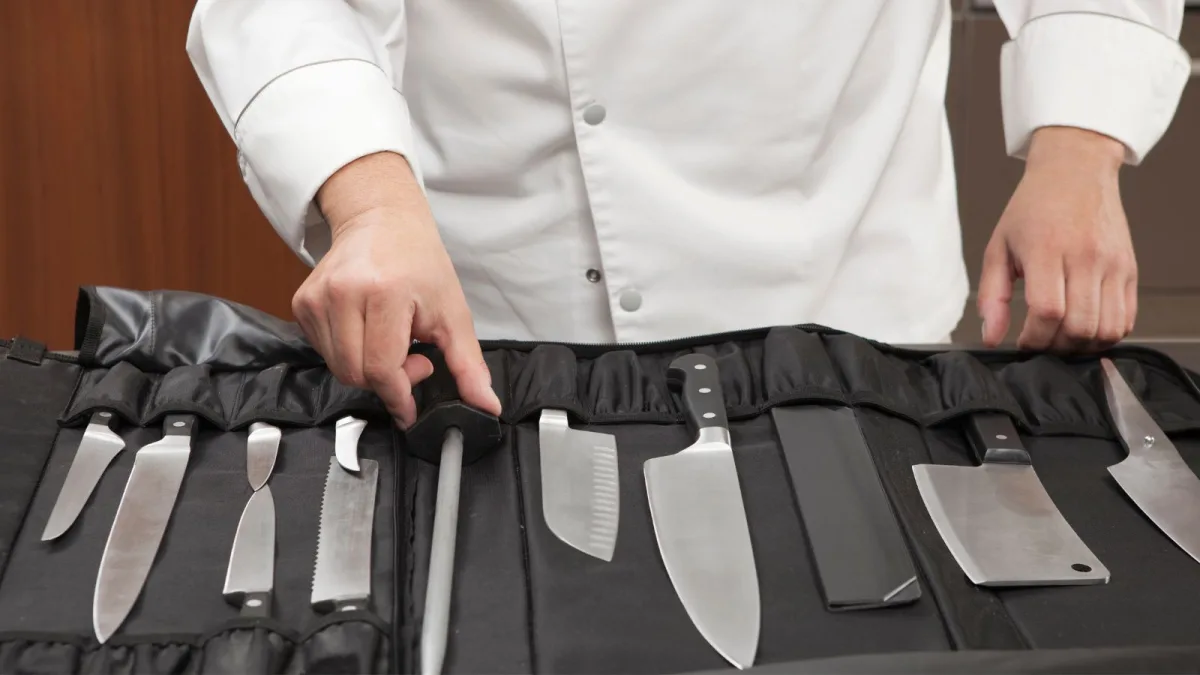
Then there are knife rolls and bags. These are great for chefs who are on the go, caterers, pop-up chefs, or anyone who needs to transport their knives regularly. But here’s the thing: not all knife rolls are created equal. You want one with individual slots for each knife, so the blades don’t rub against each other. And make sure the material is durable and easy to clean, leather might look nice, but it’s not the most sanitary option. I’ve had good luck with rolls made from heavy-duty nylon or canvas, they’re tough, easy to clean, and they protect your knives well.
And finally: in-drawer knife organizers. These are a good option if you’re short on counter or wall space, but they come with their own set of challenges. The biggest issue? It’s easy to forget a knife is in the drawer and accidentally grab the blade when you’re reaching for something else. If you’re using an in-drawer organizer, make sure it’s one with a protective cover or individual slots for each knife. And always store your knives with the edge facing up, this helps protect the blade and keeps you from accidentally cutting yourself.
Oh, and one more thing: ever store your knives loose in a drawer. I don’t care how careful you are, sooner or later, you’re going to reach into that drawer and grab the blade instead of the handle. It’s a recipe for disaster, and it’s just not worth the risk. Invest in a proper storage solution, and your knives (and your fingers) will thank you.
The Step-by-Step Guide to Sharpening Like a Pro (Even If You’re a Beginner)
7. The Angle Debate: Finding the Sweet Spot for Your Knife
Sharpening a knife is all about angle control. Get the angle wrong, and you’ll either dull the edge or create a blade that’s too fragile to hold up in a commercial kitchen. But what’s the right angle? It depends on the knife. Most Western-style knives (like your standard chef’s knife or paring knife) are sharpened at a 20-degree angle. Japanese knives, on the other hand, are often sharpened at a steeper 15-degree angle, which gives them a sharper (but more delicate) edge.
So, how do you find the right angle? Here’s a trick I learned from an old-school sushi chef: use a matchbook. The spine of a matchbook is roughly the same thickness as the angle you want for a Western-style knife. Place the matchbook under the blade, and use it as a guide to maintain a consistent angle while you sharpen. It’s not perfect, but it’s a good starting point if you’re new to sharpening.
But here’s the thing: consistency is more important than the exact angle. If you’re sharpening at a 20-degree angle on one side and a 25-degree angle on the other, you’re going to end up with a lopsided edge. The key is to pick an angle and stick with it. And don’t worry too much about getting it perfect, with practice, you’ll develop a feel for the right angle, and it’ll become second nature.
Oh, and one more thing: don’t forget to flip the knife. It’s easy to get into a rhythm and forget to switch sides, but if you only sharpen one side of the blade, you’ll end up with a knife that pulls to one side when you cut. Always sharpen both sides equally, and you’ll end up with a blade that’s sharp and true.
8. The Sharpening Process: A Step-by-Step Breakdown
Alright, let’s get into the nitty-gritty of sharpening. Here’s a step-by-step breakdown of how I sharpen my knives, from start to finish. Keep in mind, this is just one method, there are plenty of ways to sharpen a knife, and you might find a technique that works better for you. But this is what’s worked for me over the years, so I’m sticking with it.
First, soak your whetstone. If you’re using a water stone (which I recommend for most sharpening tasks), you’ll need to soak it in water for about 10-15 minutes before you start. This helps the stone absorb water, which keeps it from drying out and helps remove the metal particles as you sharpen. If you’re using an oil stone, you’ll need to use honing oil instead of water, but I prefer water stones because they’re easier to clean and maintain.
Next, set up your workspace. You’ll want a stable surface to work on, ideally, a countertop or table that’s at a comfortable height. Place a damp towel under the stone to keep it from slipping while you work. And make sure you have plenty of light, you’ll need to see what you’re doing, especially when you’re checking the edge for sharpness.
Now, start with the coarse stone. If your knife is very dull or damaged, you’ll want to start with a coarse stone (around 400-grit) to remove material and reshape the edge. Hold the knife at the correct angle (remember the matchbook trick?), and push the blade across the stone in a smooth, controlled motion. Start at the heel of the blade and work your way to the tip, applying even pressure as you go. Repeat this process 10-15 times on each side of the blade, or until you’ve established a new edge.
Once you’ve established the edge, switch to a finer stone. Move up to a 1000-grit stone to refine the edge, and then to a 3000-grit stone to polish it. The process is the same: push the blade across the stone at a consistent angle, starting at the heel and working your way to the tip. Repeat this process 10-15 times on each side, or until the edge feels smooth and sharp.
After you’ve polished the edge, honing the blade. Use a honing steel to realign the edge and remove any burrs that might have formed during sharpening. Hold the steel vertically, and run the blade down the steel at a 20-degree angle, starting at the heel and working your way to the tip. Repeat this process 5-10 times on each side, or until the edge feels smooth and straight.
Finally, test the edge. There are a few ways to test the sharpness of your knife. One is the paper test: hold a sheet of paper vertically, and try to slice through it with the knife. If the knife cuts cleanly, it’s sharp. If it tears or catches, you’ll need to do a little more work. Another test is the tomato test: try slicing a tomato with the knife. If the blade glides through the skin without crushing the tomato, it’s sharp. If it squishes the tomato, you’ll need to sharpen it some more.
And that’s it! Sharpening a knife takes practice, so don’t be discouraged if your first few attempts don’t turn out perfectly. The more you do it, the better you’ll get. And remember: a sharp knife is a safe knife. So take your time, be patient, and don’t rush the process.
9. The Honing Habit: How to Keep Your Edge Between Sharpenings
Sharpening your knives is important, but it’s not something you need to do every day. In fact, if you’re sharpening your knives too often, you’re probably doing something wrong. The key to maintaining a sharp edge is honing. Honing doesn’t remove material from the blade, it realigns the edge, keeping it straight and true between sharpenings. And the best part? It only takes a few seconds.
So, how often should you hone your knives? It depends on how much you use them. If you’re in a high-volume kitchen, you might want to hone your knives every few hours. If you’re in a lower-volume setting, once a day might be enough. The key is to pay attention to how your knives are performing. If you notice the edge starting to dull or the knife pulling to one side, it’s time to hone.
Here’s how I hone my knives: I hold the honing steel vertically, with the tip resting on a stable surface. Then, I run the blade down the steel at a 20-degree angle, starting at the heel and working my way to the tip. I repeat this process 5-10 times on each side of the blade, or until the edge feels smooth and straight. It’s a quick, easy process, and it makes a big difference in how your knives perform.
But here’s the thing: honing isn’t a substitute for sharpening. If your knife is already dull, honing isn’t going to fix it. Honing is like flossing, it’s something you do regularly to maintain your edge, but it’s not a replacement for the deep clean (or, in this case, the full sharpening). So, don’t rely on honing to keep your knives sharp. Use it as a maintenance tool, and sharpen your knives when they need it.
Oh, and one more thing: don’t overdo it. Honing too often can actually wear down the edge of your knife, especially if you’re using a coarse honing steel. Stick to the recommended frequency, and your knives will stay sharper longer.
The Little Habits That Make a Big Difference (And the Mistakes You’re Probably Making)
10. The Prep Matters: How to Set Up Your Workstation for Knife Longevity
You wouldn’t believe how much of knife maintenance comes down to how you use your knives. It’s not just about sharpening and cleaning, it’s about the little habits you develop in the kitchen. For example, did you know that the surface you’re cutting on can make a huge difference in how long your edge stays sharp? A hard cutting board (like glass or stone) will dull your knife faster than a soft one (like wood or plastic). I’ve seen chefs ruin a brand-new knife in a single shift just by chopping on a granite countertop. Don’t be that chef.
So, what’s the best cutting board for your knives? Wood is the gold standard, it’s gentle on the edge, it’s durable, and it’s easy to clean. But not all wood is created equal. Hardwoods like maple or walnut are ideal because they’re dense enough to resist deep grooves, but soft enough to protect your blade. Avoid softwoods like pine, they’re too soft, and they’ll wear down your knife faster.
Plastic cutting boards are another good option, especially in a commercial kitchen where sanitation is a priority. They’re easy to clean, they’re lightweight, and they won’t dull your knife as quickly as a hard surface. But here’s the catch: not all plastic boards are created equal. You want one that’s thick and sturdy, thin plastic boards can warp over time, which can damage your knife. And make sure to replace your plastic boards regularly, they can develop deep grooves that harbor bacteria and dull your edge.
And here’s a pro tip: rotate your cutting boards. If you’re using the same board for everything, meat, vegetables, fish, you’re going to wear it out faster. Instead, use one board for proteins, one for vegetables, and one for bread or other dry ingredients. This not only extends the life of your boards, but it also helps prevent cross-contamination.
Oh, and one more thing: don’t use your knife as a pry bar. I don’t care how tempting it is, using your knife to open a jar, scrape food off a cutting board, or (god forbid) cut through bone is a surefire way to ruin the edge. Knives are designed for cutting, not prying. If you need to open a jar, use a jar opener. If you need to scrape food off a cutting board, use a bench scraper. Your knives will thank you.
11. The Cleaning No-Nos: What You’re Doing Wrong (And How to Fix It)
We’ve already talked about the basics of cleaning your knives, but there are a few common mistakes that even experienced chefs make. Let’s go over them, so you can avoid the same pitfalls.
First up: using the wrong sponge. I get it, those green scrubby sponges are great for cleaning pots and pans. But they’re terrible for knives. The abrasive surface can scratch the blade, which not only dulls the edge but also creates micro-scratches that harbor bacteria. Instead, use a soft sponge or cloth to clean your knives. If you’re dealing with stubborn food residue, a little baking soda or a non-abrasive cleaner can help, but be gentle.
Next: soaking your knives. I mentioned this earlier, but it’s worth repeating: soaking your knives is a bad idea. It can cause the handle to loosen, the blade to rust, and the edge to dull. Instead, wash your knives immediately after use, dry them thoroughly, and put them away. If you’re in a rush, at least rinse the knife and dry it as much as possible before setting it aside.
Then there’s the dishwasher dilemma. I know, I know, dishwashers are convenient. But they’re also the enemy of good knives. The high heat, harsh detergents, and jostling against other dishes can dull the edge, damage the handle, and even cause the blade to chip. If you’re in a commercial kitchen, this should be a no-brainer, but I’ve seen enough chefs make this mistake to know it’s worth repeating. Wash your knives by hand, dry them thoroughly, and put them away.
And finally: using the wrong drying towel. Not all towels are created equal. A rough towel can scratch the blade, while a dirty towel can transfer bacteria to the knife. Instead, use a clean, soft towel to dry your knives. I keep a dedicated towel in my knife kit just for drying my blades, it’s a small step, but it makes a big difference.
Oh, and one more thing: don’t forget to clean the handle. It’s easy to focus on the blade and forget about the handle, but the handle can harbor just as much bacteria as the blade. Make sure to clean the handle thoroughly, especially if it’s made of wood or another porous material. And if the handle is loose or damaged, get it repaired or replaced, it’s not worth risking your safety over a loose handle.
12. The Storage Struggles: How to Keep Your Knives Safe (And Your Fingers Intact)
We’ve already talked about the different storage options for your knives, but there are a few more things to keep in mind. For example, did you know that storing your knives in a damp environment can cause them to rust? It’s true. If you’re storing your knives in a humid kitchen or a damp knife roll, you’re setting yourself up for disaster. Instead, make sure your knives are stored in a dry, well-ventilated area. If you’re using a knife roll, let it air out after each use to prevent moisture buildup.
Another common mistake: storing your knives with the edge facing down. This might seem like a good idea, after all, it keeps the edge from getting damaged, right? Wrong. Storing your knives with the edge facing down can actually dull the edge over time, especially if the blade is resting on a hard surface. Instead, store your knives with the edge facing up, or use a storage solution that keeps the blade from touching anything else.
And here’s a pro tip: don’t store your knives in a cluttered drawer. I don’t care how careful you are, sooner or later, you’re going to reach into that drawer and grab the blade instead of the handle. It’s a recipe for disaster, and it’s just not worth the risk. Instead, invest in a proper storage solution, like a magnetic strip, a knife block, or a knife roll. Your knives (and your fingers) will thank you.
Oh, and one more thing: don’t forget to inspect your knives regularly. Over time, even the best knives can develop nicks, chips, or other damage. Make it a habit to inspect your knives regularly, and address any issues as soon as they arise. If you notice a small chip in the blade, get it repaired before it becomes a bigger problem. If the handle is loose, get it tightened. A little maintenance now can save you a lot of headaches later.
Putting It All Together: A Maintenance Routine That Actually Works
Alright, let’s recap. We’ve covered a lot of ground in this guide, from the basics of knife sharpening to the little habits that’ll extend the life of your blades. But how do you put it all together into a routine that actually works in a busy kitchen? Here’s a simple, step-by-step maintenance routine that you can adapt to your own needs.
First, clean your knives after every use. Wash them with hot, soapy water, dry them thoroughly, and put them away. This might seem like a no-brainer, but it’s the most important step in knife maintenance. A clean knife is a safe knife, and it’s the first step in keeping your blades in top condition.
Next, hone your knives regularly. How often you hone depends on how much you use your knives, but a good rule of thumb is to hone them every few hours in a high-volume kitchen, or once a day in a lower-volume setting. Use a honing steel to realign the edge, and pay attention to how your knives are performing. If you notice the edge starting to dull, it’s time to hone.
Then, sharpen your knives when they need it. How often you sharpen depends on how much you use your knives and how well you maintain them. In a high-volume kitchen, you might need to sharpen your knives every few weeks. In a lower-volume setting, you might only need to sharpen them every few months. The key is to pay attention to how your knives are performing. If they’re not cutting as well as they used to, it’s time to sharpen.
Finally, inspect your knives regularly. Over time, even the best knives can develop nicks, chips, or other damage. Make it a habit to inspect your knives regularly, and address any issues as soon as they arise. If you notice a small chip in the blade, get it repaired before it becomes a bigger problem. If the handle is loose, get it tightened. A little maintenance now can save you a lot of headaches later.
And that’s it! It’s a simple routine, but it’s one that’ll keep your knives in top condition for years to come. The key is to be consistent, don’t wait until your knives are dull or damaged to start maintaining them. Make knife maintenance a habit, and your blades will thank you.
So, what’s the takeaway? Knife maintenance isn’t just about keeping your blades sharp, it’s about safety, efficiency, and respect for your tools. A well-maintained knife doesn’t just cut better; it cuts faster, with less effort, and with way fewer accidents. And in a commercial kitchen, that’s everything.
I’ll leave you with this: the next time you’re prepping for a shift, take a minute to look at your knives. Are they clean? Are they sharp? Are they stored properly? If not, it’s time to make a change. Your knives are the most important tools in your kitchen, treat them that way.
FAQ: Your Commercial Knife Maintenance Questions, Answered
Q: How often should I sharpen my commercial knives?
A: It depends on how much you use them. In a high-volume kitchen, you might need to sharpen your knives every few weeks. In a lower-volume setting, you might only need to sharpen them every few months. The key is to pay attention to how your knives are performing. If they’re not cutting as well as they used to, it’s time to sharpen. And don’t forget to hone your knives regularly, this can help extend the time between sharpenings.
Q: What’s the best way to store my knives in a commercial kitchen?
A: There are a few good options, depending on your needs. Magnetic knife strips are great for keeping your knives within easy reach while protecting the edge. Knife blocks are another good option, but make sure they have horizontal slots to keep the blade from resting on the edge. Knife rolls and bags are ideal for chefs who are on the go, but make sure they have individual slots for each knife. And whatever you do, don’t store your knives loose in a drawer, it’s a safety hazard, and it can dull the edge.
Q: Can I put my knives in the dishwasher?
A: No. Dishwashers are the enemy of good knives. The high heat, harsh detergents, and jostling against other dishes can dull the edge, damage the handle, and even cause the blade to chip. Always wash your knives by hand, dry them thoroughly, and put them away.
Q: What’s the best cutting board for my knives?
A: Wood is the gold standard, it’s gentle on the edge, it’s durable, and it’s easy to clean. Hardwoods like maple or walnut are ideal because they’re dense enough to resist deep grooves, but soft enough to protect your blade. Plastic cutting boards are another good option, especially in a commercial kitchen where sanitation is a priority. Just make sure to replace them regularly, as they can develop deep grooves that harbor bacteria and dull your edge.
@article{commercial-knife-maintenance-tips-every-professional-chef-should-know-but-probably-forgets,
    title   = {Commercial Knife Maintenance Tips Every Professional Chef Should Know (But Probably Forgets)},
    author  = {Chef's icon},
    year    = {2026},
    journal = {Chef's Icon},
    url     = {https://chefsicon.com/commercial-knife-maintenance-tips-professional-chefs/}
}